Double Drag Rip: Oklahoma State's Lob Play Explained
Double Drag Rip is an early-offense lob play. The 4 and 5 set back-to-back drag screens for the 1. Then the 4 turns and screens for the 5 at the elbow, and the 5 rips to the rim for a lob. Oklahoma State used it against Michigan in the 2017 NCAA Tournament.

By Coach On, CoachesPad. Broken down from the game film.
Two ball screens up top, and every eye in the gym goes to the ball. That is the whole idea behind Double Drag Rip. The double drag pulls the defense toward the point guard, and while everyone is watching him, the first screener turns around and screens for the second one. The 5 rips to the rim behind it, and the lob goes up into an empty lane.
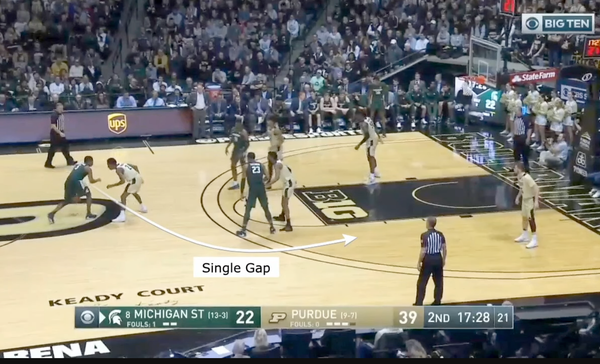
Oklahoma State ran it against Michigan in the first round of the 2017 NCAA Tournament, a 92-91 Michigan win in Indianapolis. On the film it takes about six seconds from the point guard crossing half court to the dunk. Below is how to set it up, why it works, what to do when the defense takes it away, and how to teach it in four practice steps.
Quick summary
| What it is | An early-offense lob play. Two trailing bigs set a double drag for the point guard, then the first screener screens for the second, who rips to the rim for a lob. |
|---|---|
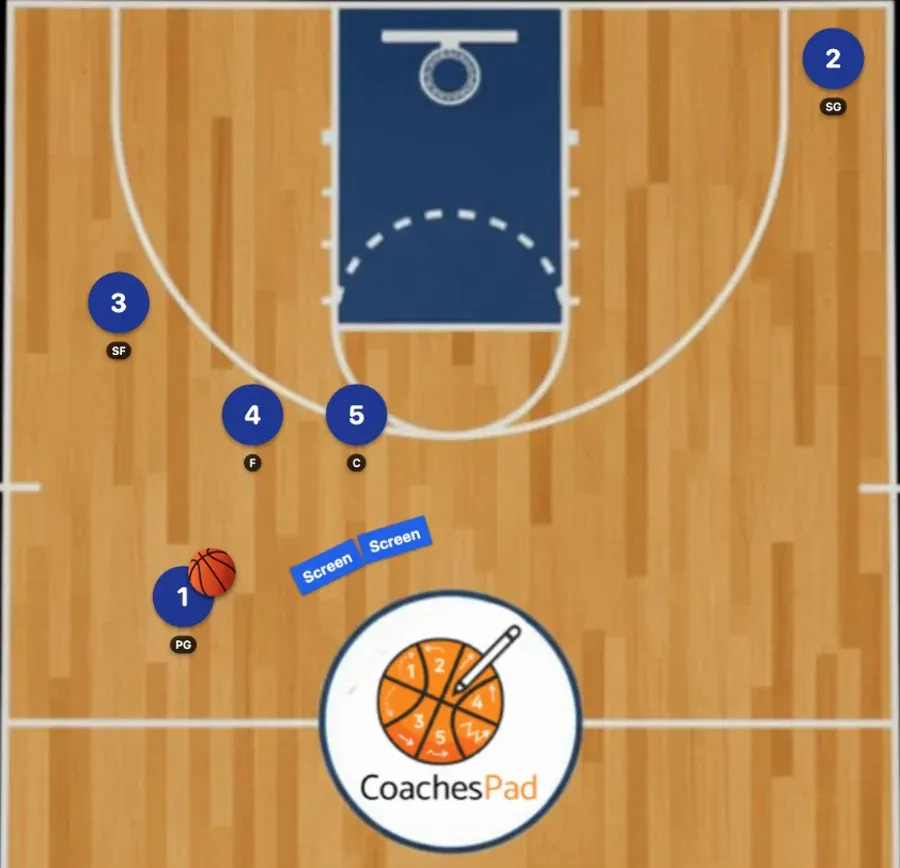
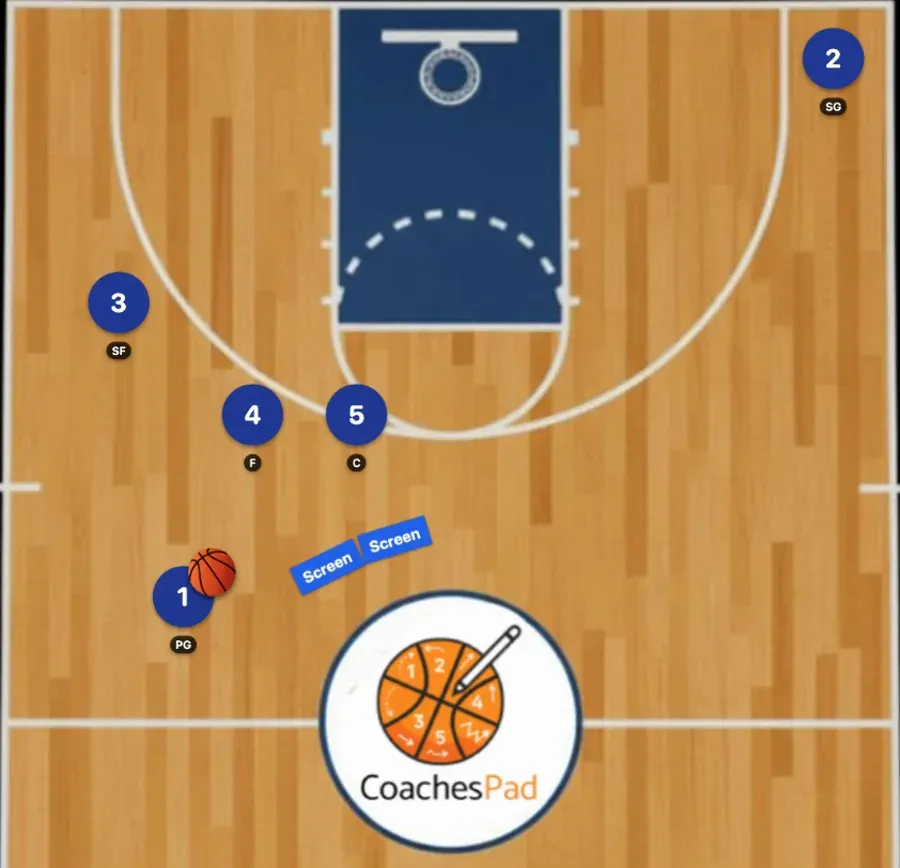
| Formation | Transition / secondary break: 1 pushes up the left side, 4 and 5 trail, 3 on the left wing, 2 in the right corner. |
| Who it is for | High school, college and strong club teams with a point guard who can throw a lob off the dribble and a big who can catch above the rim (or at least at it). |
| Best against | Man-to-man defenses that load up on ball screens: hedging, showing, or sending help toward the ball. |
| Not for | Zones, or a defense that is fully set and switching everything with matched size. |
| Get the play | Share code L7JS94W8 in the CoachesPad app, or open it here. |
Terms used in this play
Coaches use these words differently from program to program, so here is exactly what they mean in this breakdown.
- Drag screen. A ball screen set in transition or early offense, usually by a trailing big running into it, before the defense is organized. The point is to screen the ball before the defense has decided how it will guard ball screens.
- Double drag. Two drag screens in a row for the same ball handler, one screener behind the other. Some playbooks call it "77." The ball handler comes off both, and the defense now has two screeners to account for instead of one.
- Screen the screener. A player who just set a screen gets screened himself. In this play it works the other way around, which is the twist: the first drag screener (4) sets the screen for the second drag screener (5).
- Rip screen / rip cut. "Rip" is a common name for a back screen: the screener stands with his back to the basket, and the cutter runs off him toward the rim. The cutter's move is the rip cut. Here 4 sets it at the left elbow and 5 rips from above him down to the rim.
- Lob. A high pass thrown above the defense for a cutter to catch at or above the rim. A good lob is thrown to a spot, not to the player, so he can run under it.
- Trailer. A big who runs the floor behind the ball in transition. Both drag screeners here are trailers.
- Hedge. The screener's defender jumps out at the ball handler to slow him down, then recovers to his own man.
- Drop. The screener's defender sinks back toward the paint instead of stepping up, protecting the rim while the guard's defender chases over the screen.
- Switch. The two defenders trade assignments when the screen is set.
- ICE. Programs use different names for it. The ball handler's defender sits on the screen side and pushes the ball away from the screen, toward the sideline, so he cannot use it.
Personnel: what each spot needs
The play runs on two skills: a lob thrown on time, and a big who catches it in traffic. Everything else is spacing.
- 1 (point guard): Pushes the ball hard so the drags hit before the defense is set. He has to keep his dribble alive coming off two screens, keep his eyes up, and throw a lob off the dribble from the right slot. If he cannot throw that pass, do not run the play.
- 4 (first drag screener): The quiet hero. He sets the first drag, then goes straight to the left elbow and sets a second screen for the 5. He needs to be big and physical enough that the second screen actually hits a body.
- 5 (second drag screener): Your lob catcher. He sets the second drag, drifts up top, and then has to explode around the 4's screen and go up for the ball. Hands, timing and a quick second jump matter more than size.
- 3 (left wing): Runs through from the left wing to the right wing. His job is to drag his defender out of the left side of the floor.
- 2 (right corner): Stays in the right corner the whole play. A shooter here holds his defender out of the lane on the ball side.
The alignment
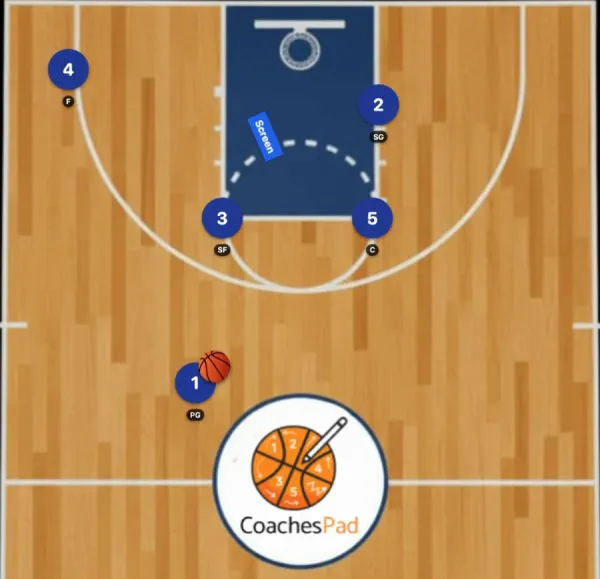
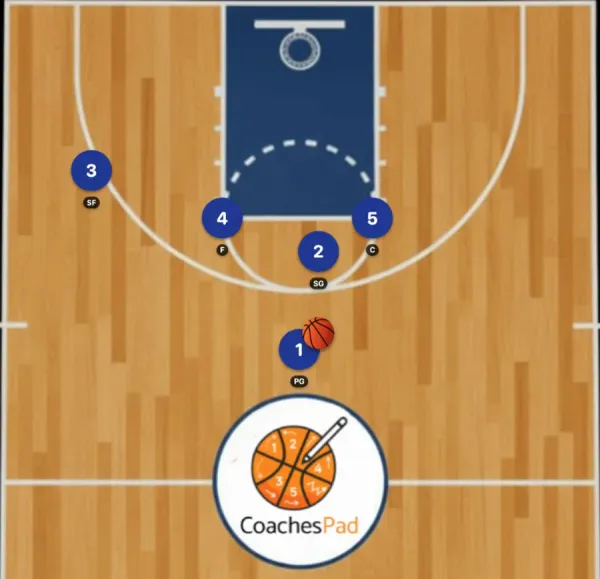
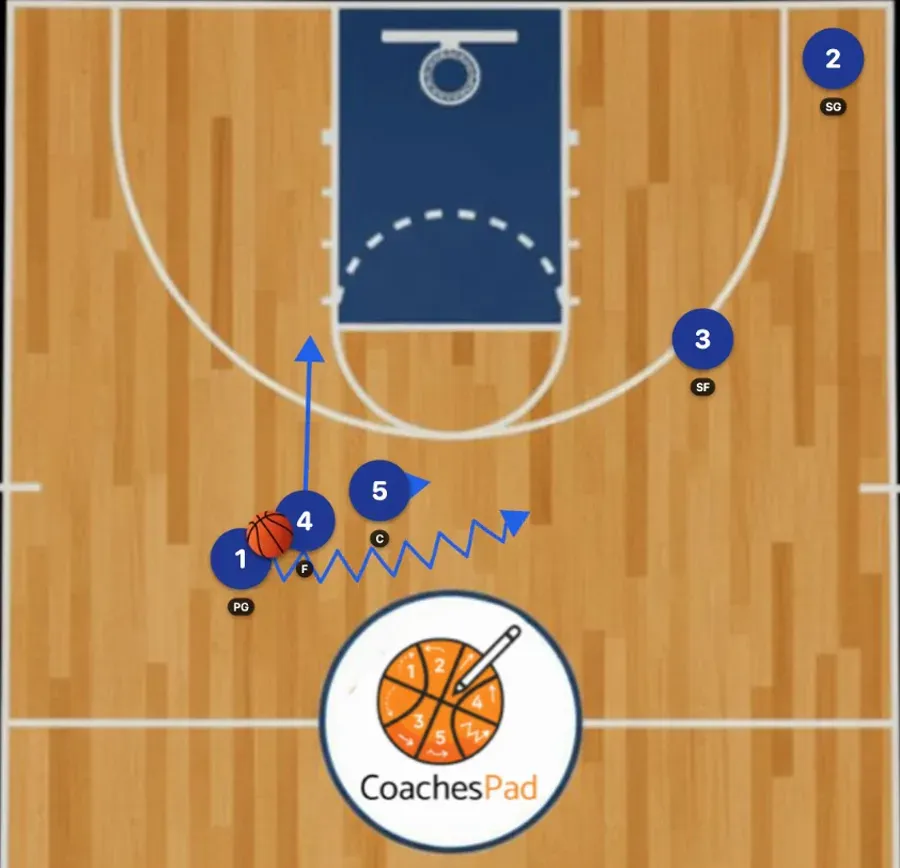
This is early offense, so the "alignment" is where everybody is as the ball crosses half court. 1 brings it up the left side. 4 and 5 are trailing, a step apart, ready to run into the drags. 3 is on the left wing, and 2 is already sitting in the right corner.
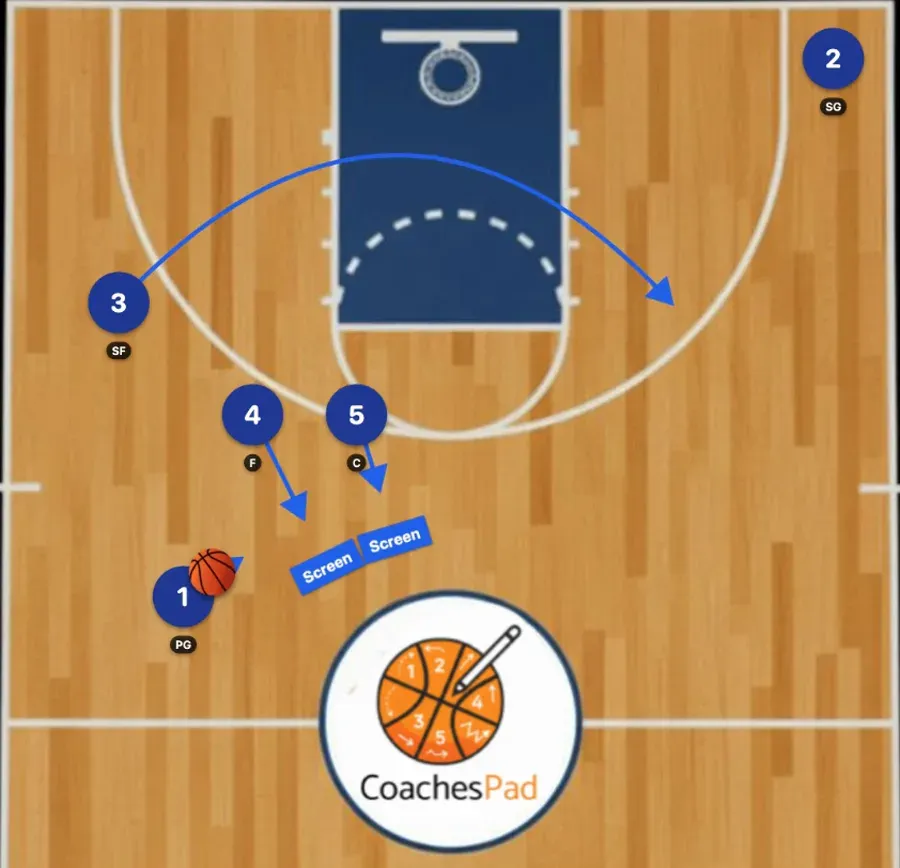
The first movement happens right away. 4 and 5 run in to set the double drag, one behind the other, while 3 runs from the left wing all the way through to the right wing. When it is done, three offensive players and their defenders are on the right side of the floor, and the left side is almost empty. That empty left side is where the lob will land.
Step-by-step
Step 1: The double drag
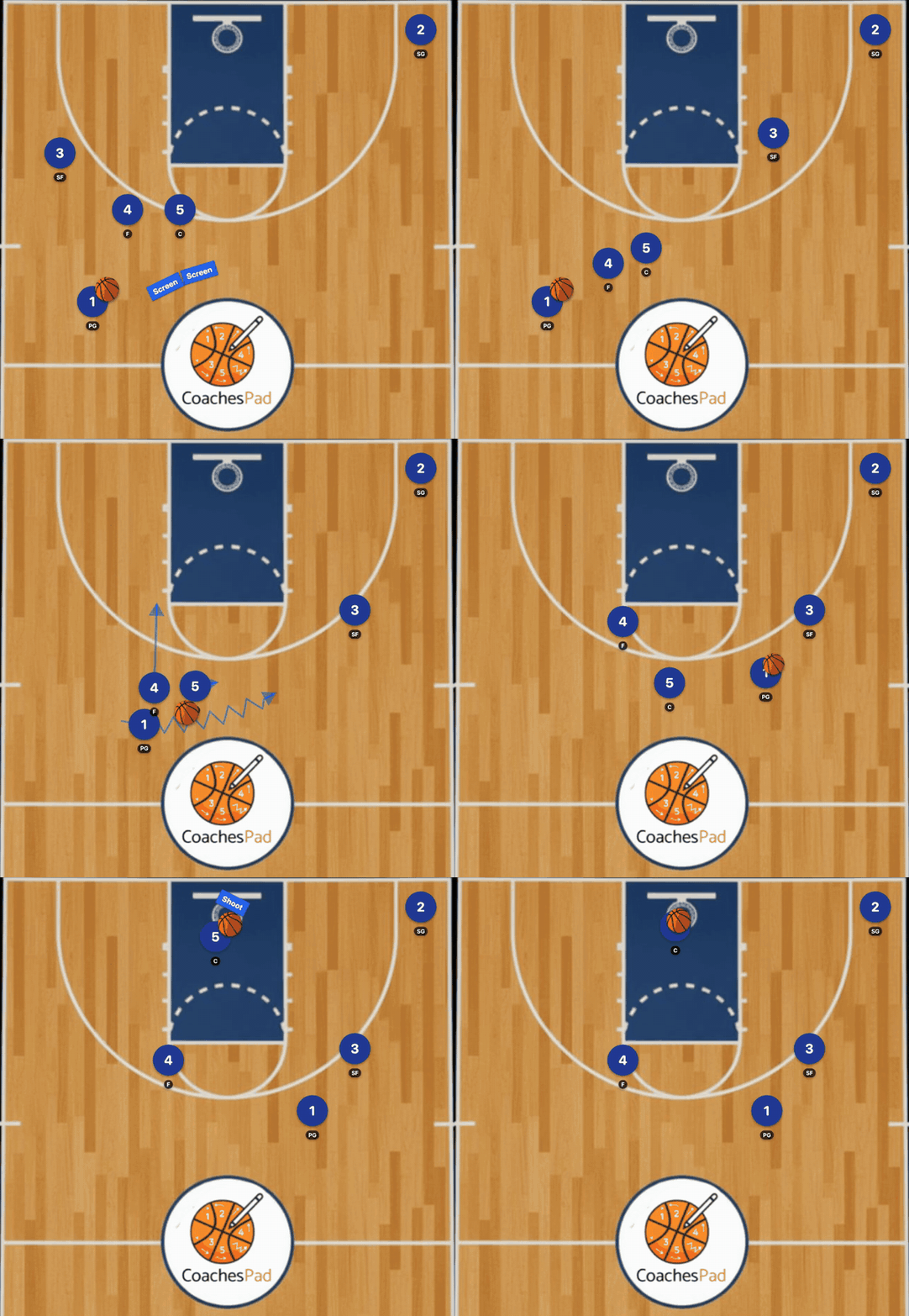
4 sets the first drag screen at the left slot. 5 sets the second one right behind it, just left of the top of the key. 1 dribbles over both screens going right and comes out on the right side of the top.
As soon as 1 clears the screens, the two screeners split. 4 goes straight to the left elbow. He does not pop out to the slot first. He is going to the spot that gives him the best angle for his next screen. 5 drifts up and to the left, above the 4, and waits.
Now the defense is turned toward the ball. 1's defender is chasing over two screens, and both big defenders have just had to deal with a ball handler coming right at them.
Step 2: 4 screens for the 5
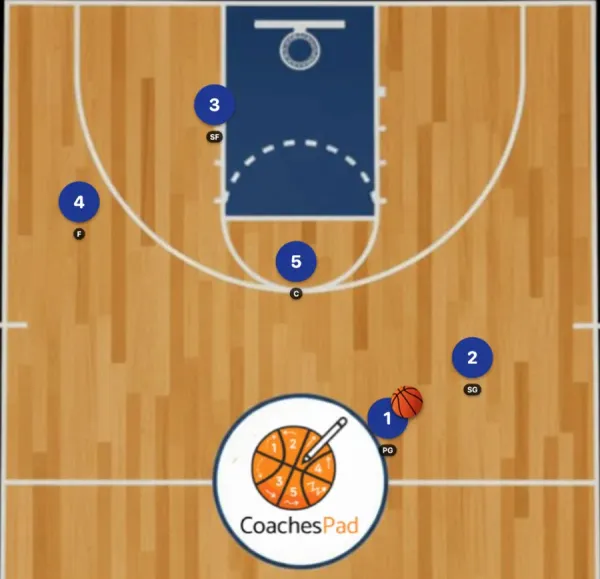
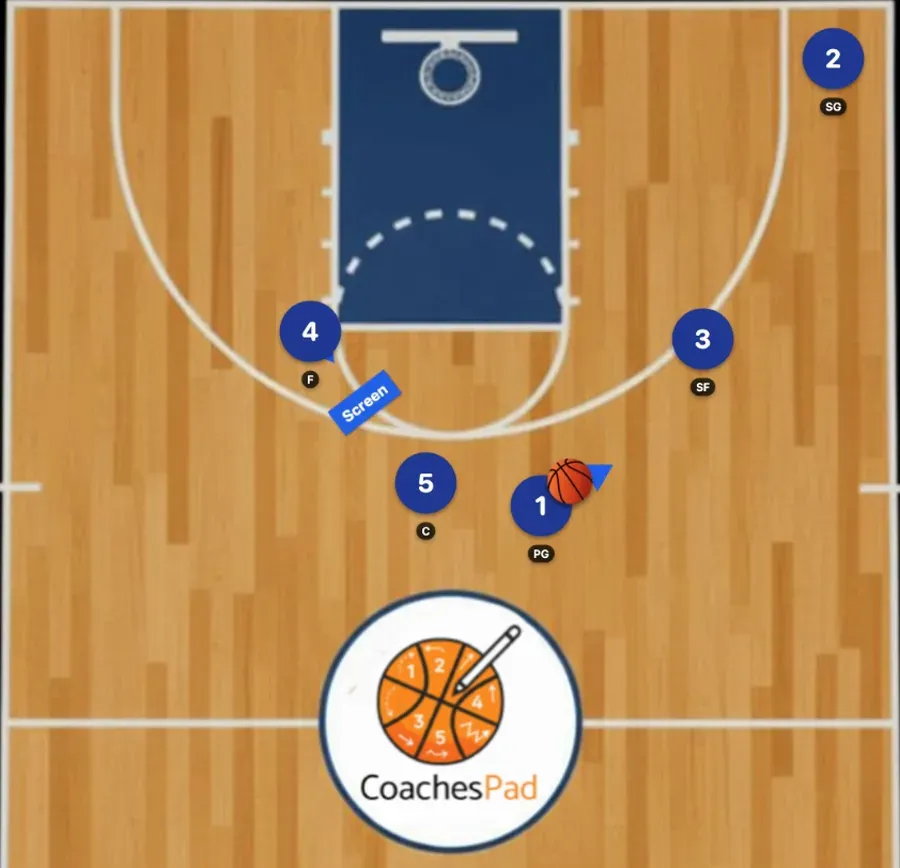
1 keeps dribbling to the right slot. At the left elbow, 4 turns and sets a screen on 5's defender. This is the rip screen: 4's back is to the basket, and 5 is above him.
Look at the floor: 1, 2 and 3 are all on the right side. The left side of the lane is open, and the only defender who could protect it is the one about to run into the 4.
Step 3: The rip and the lob
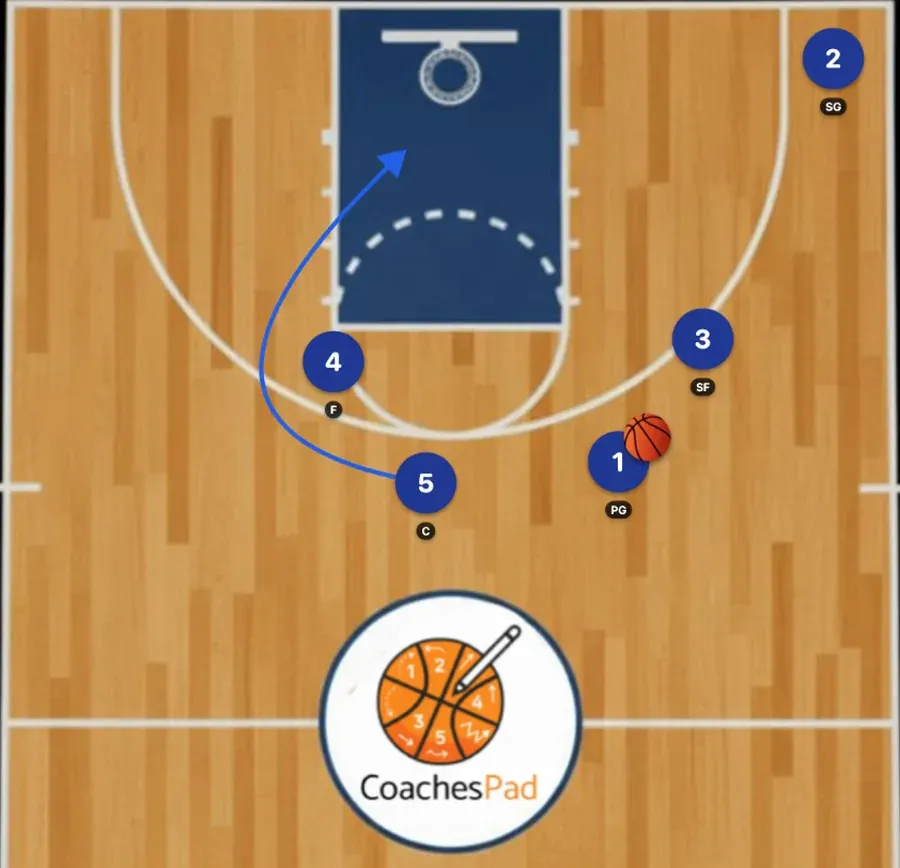
5 comes off the screen around the outside of the 4, on the left side of him, and rips down to the rim. 1 throws the lob from the right slot.
The direction matters. If 5 cuts inside, between the 4 and the ball, he runs into his own defender and into whatever help is in the middle. Going around the outside uses the 4 as a wall and puts the 5 on a clean line to the left side of the rim, where nobody is standing.
Timing: 5 does not cut until the screen is set. On the film the screen lands first, then the cut, then the pass.
Step 4: The catch
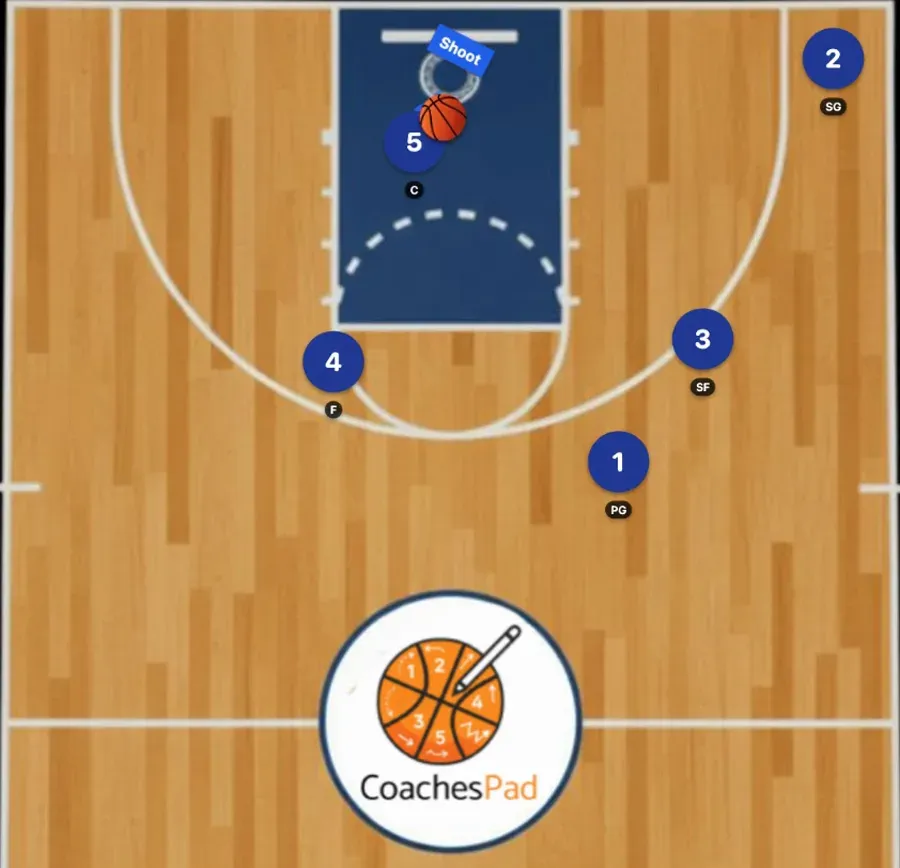
5 catches the lob at the rim, on the left side of it. The pass is thrown to the rim, not to where the 5 is when 1 lets go. 5 runs under it and goes up.
Step 5: The finish
5 throws it down. On the film he hangs on the rim and the shot clock resets. If your 5 cannot dunk, the same catch turns into a two-hand finish off the glass. The lob does not have to be high; it has to be over the defense and on time.
Why it works
The defense is solving the wrong problem. A double drag in early offense is a real threat. The defense has to decide, on the run, how to guard two ball screens, and all five defenders turn toward the ball to do it. By the time 1 reaches the right side, the defense has spent its attention on him.
The second screener is the forgotten man. After a drag, defenders watch the first screener roll or pop. Nobody expects the second screener to be the target. 5 drifting up top looks like a big getting out of the way. That is exactly why his defender relaxes.
The 4 gets a free angle. Going straight to the elbow puts the 4 between 5's defender and the basket. His man is still recovering from the drag, so nobody is bothering him while he sets up.
The left side is empty. 3 ran through to the right wing and 2 never left the right corner. Their defenders are on the right side, guarding shooters near the ball. In a help-heavy defense like the pack line, the weak-side defenders are the ones who protect the rim. This play takes them out of the weak side before the cut happens.
The lob beats the help. Even if a defender sees the rip late, a bounce or chest pass would have to go through him. A lob goes over him. The only person who can stop it is 5's own defender, and he is stuck on the 4.
Reads and counters: defense does X, offense does Y
A good defense will not give you the lob every time. Here is what you will see and what to teach.
| Defense does | Offense does |
|---|---|
| Hedges or shows hard on the drags | This is what the play wants. The big defenders are out high, so the rim is open when 5 rips. Run it as drawn. |
| Drops on the drags (bigs sink toward the paint) | The lob is harder, because 5's defender is already deep. 1 can pull up or keep driving downhill off the drags. If 5's man sinks, 5 stays up top and gets the ball back for a two-big action with 4. |
| Switches the drags | Look for the mismatch. If a guard ends up on the 5, the rip and lob are even better, because the smaller defender has to fight through the 4's screen and then contest a lob. If a big is on 1, he can attack him off the dribble. |
| ICEs the first drag (pushes 1 left, away from the screens) | 1 cannot get right, so the angle for the lob changes. 4 and 5 can flip their screens to the other side, or 1 rejects and drives left and the 4 rolls. Run the rip from the other side next time down. |
| 5's defender goes under the 4's screen or cheats to the rim | 5 stops on the screen and pops back out above the arc, or 4 slips to the rim himself after the screen. 5's defender cannot guard both. |
| The defender on 4 helps early on the rip | 4 is open. He slips to the basket or steps to the left block for a pass from 1. |
| Weak-side help comes across from the right side | That defender left 3 on the right wing or 2 in the corner. 1 kicks to the open shooter instead of throwing the lob. |
The principle behind all of these: 1 reads 5's defender, not the 5. If that defender is stuck on the 4, throw it up. If he got through, find whoever the help left.
Teaching it in practice
The play is a timing play between three players. Build the timing before you add the other two.
Drill 1: Lob passing off the dribble (1 and 5)
1 dribbles from the top to the right slot. 5 starts above the left elbow. On a coach's call, 5 sprints to the rim and 1 throws the lob to the left side of the rim. No defense.
- Reps: 10 good catches, then switch sides.
- Coaching points: throw to the rim, not to the cutter. Soft touch, high arc. 5 calls for it with a hand up. If it is short or flat, it is the wrong pass.
Drill 2: Screen and rip (4 and 5, plus a passer)
4 starts at the left slot, 5 just left of the top. A coach has the ball at the right slot. 4 runs straight to the left elbow and sets the screen. 5 waits until the screen is set, then rips around the outside to the rim. The coach throws the lob. Add a dummy defender on 5 who has to go through or around the screen.
- Reps: 3 minutes, rotate 4 and 5 every rep.
- Coaching points: 4 sets a legal, stopped screen with a wide base. 5 sets his man up by walking him away first, then cuts shoulder to hip off the 4. 5 always goes around the outside.
Drill 3: 5-on-0 from half court
Run the whole play from the push: 1 up the left side, 4 and 5 into the double drag, 3 through to the right wing, 2 in the right corner. Then add the counters on a coach's call ("drop," "switch," "under") so players learn the second option without stopping.
- Reps: 8 to 10 clean runs, then 2 runs of each counter.
- Coaching points: 1 has to push. A walked-up double drag lets the defense set. 3 must clear the left side before the rip.
Drill 4: Transition 5-on-5 with a trigger
Start with a defensive rebound or made basket and play it live up the floor. The offense must flow into Double Drag Rip on every possession for 5 minutes. Points: 2 for a lob finish, 1 for any other score off a correct read, minus 1 for a turnover.
After a few rounds, let the defense guard the drags however it wants. Now 1 has to read the coverage. This is where you find out if your point guard and your 5 are on the same page.
Common mistakes and fixes
- The drags come too late. If 1 walks it up and the bigs jog, the defense is set and loaded up on the screens. Fix: 1 pushes, and 4 and 5 sprint to their spots as trailers.
- 4 pops to the slot before the elbow. The extra steps kill the timing and give 4 a bad angle. Fix: off the drag, straight to the left elbow.
- 4 and 5 end up on top of each other. If 5 drifts to the same spot, there is no room to go around the screen. Fix: 5 stays up and to the left, clear of the 4, so his cut visibly curls around him.
- 5 cuts the wrong way. Cutting inside, toward the ball, runs him into traffic. Fix: always around the outside of the 4.
- 5 cuts before the screen is set. Either the screen is illegal or his defender just follows him. Fix: screen first, then cut. Drill it until the 5 waits automatically.
- 1 throws it to the player, not the spot. The lob ends up behind the cutter. Fix: aim at the rim, on the left side, and let 5 run under it.
- 3 does not clear. If 3 stays on the left wing, his defender is sitting right where the lob lands. Fix: 3 runs through to the right wing every time.
Variations
- Flip it. Push up the right side, double drag going left, 4 to the right elbow, 5 rips around the outside to the right side of the rim. Corner and wing swap sides.
- Swap the screeners. Put your lob catcher first and your best screener second. Now the second screener re-screens for the first, who curls to the rim. That version of the re-screen after a double drag is often called "Oklahoma action."
- Pop the 5. If your 5 can shoot, have him fake the rip and pop above the arc. His defender, worried about the lob, usually sags.
- 4 slips. If 4's defender starts helping on the rip, call the slip: 4 fakes the screen and dives to the rim himself.
Youth and high school adjustments
- Lower the lob. Most youth and JV bigs cannot catch above the rim. Teach a high, soft pass to the front of the rim, caught with two hands and finished with a power layup.
- Pick your 5 by hands, not height. The player who catches best in traffic should be the cutter.
- Teach legal screens first. Younger players move on screens. Make the 4 stop, set a wide base, and hold until the 5 passes.
- Simplify to one drag. If two screens are too much, have only the 5 set the drag and the 4 wait at the left elbow. The rip and the lob stay the same.
FAQ
What is a double drag screen in basketball?
A double drag is two ball screens in a row for the same ball handler, set early in the possession by trailing bigs, one behind the other. The ball handler comes off both. It is popular because the defense has to guard two screens in transition before it has organized its ball-screen coverage.
What is the difference between a drag screen and a pick and roll?
A drag screen is a ball screen, so it is a type of pick and roll. The difference is timing. A drag screen is set in transition or early offense, usually by a big who is running into it, while a half-court pick and roll is set after the defense is in place.
What is a rip screen?
Rip is a common name for a back screen. The screener has his back to the basket and the cutter runs off him toward the rim, usually from above. In Double Drag Rip, 4 sets the rip screen at the left elbow and 5 rips to the rim for the lob.
How do you defend a double drag?
Teams switch, hedge, drop, or try to keep the ball out of the middle with ICE, and some go under both screens. The hard part is communication: two screens in a row, in transition, with two big defenders who both have to know the coverage. Double Drag Rip punishes defenses that commit both bigs to the ball.
How do you throw a good lob pass?
Throw it to a spot, not to the player. Aim at the front or side of the rim with a soft, high arc, so the cutter runs under it and catches at the top of his jump. A flat, hard lob is easy to tip and hard to catch.
Does Double Drag Rip work against a zone?
Not as drawn. The play depends on 5's defender being attached to 5 and getting stuck on the 4's screen. In a zone, a defender guarding the left side of the rim simply waits for the cut. Use it against man-to-man.
Get Double Drag Rip free in CoachesPad
Open the CoachesPad iPad app and type share code L7JS94W8 to load the animated play, or open Double Drag Rip here. Step through it frame by frame with your team, synced with the game film, and add it to your playbook.
Want another play built on a decoy? Horns Nail Elbow Get, from Creighton's game in the same 2017 tournament, uses a fake handoff to turn the defense and frees a big for a dunk. And to see the help-first defense this kind of play is built to empty out, read How to Run Tony Bennett's Pack-Line Defense.
Sources
- Game context (Michigan 92, Oklahoma State 91; March 17, 2017; NCAA Midwest Region first round, Bankers Life Fieldhouse, Indianapolis): Michigan Athletics recap, Oklahoma State Athletics recap and Sports-Reference box score.
- Drag screens: Hoop Student, What Is a Drag Screen.
- Double drag ("77"), screener order and how defenses guard it: Slapping Glass, Double Drag Screens: A Primer; The Basketball Action Dictionary, "Double Drag".
- Re-screen after a double drag: Coach Hoops, Oklahoma Action.
- Rip screen as a back screen: Wikipedia, Back screen; Hoop Student, Back Screen; Breakthrough Basketball, Basic Basketball Screens.
- Ball-screen coverages (hedge, drop, switch, ICE): Breakthrough Basketball, Ball Screen Defense: Ice, Drop, and Switch; Hooper University, How to Ice Ball Screens; Hooper University, Drop Coverage.
- Pack-line help position: CoachesPad, Pack-Line Defense breakdown.
- Play actions: verified by the CoachesPad coaching staff from game film of the Oklahoma State vs Michigan broadcast.