How to Beat the Pack Line: Xavier's Horns "Eye" Play
To beat a pack line, make it guard the baseline. In Xavier's Horns Eye set, screens and a handoff move the ball to the corner, then the 2 drives baseline. Three defenders collapse on the drive, which leaves the corner shooter open for the kick-out three.

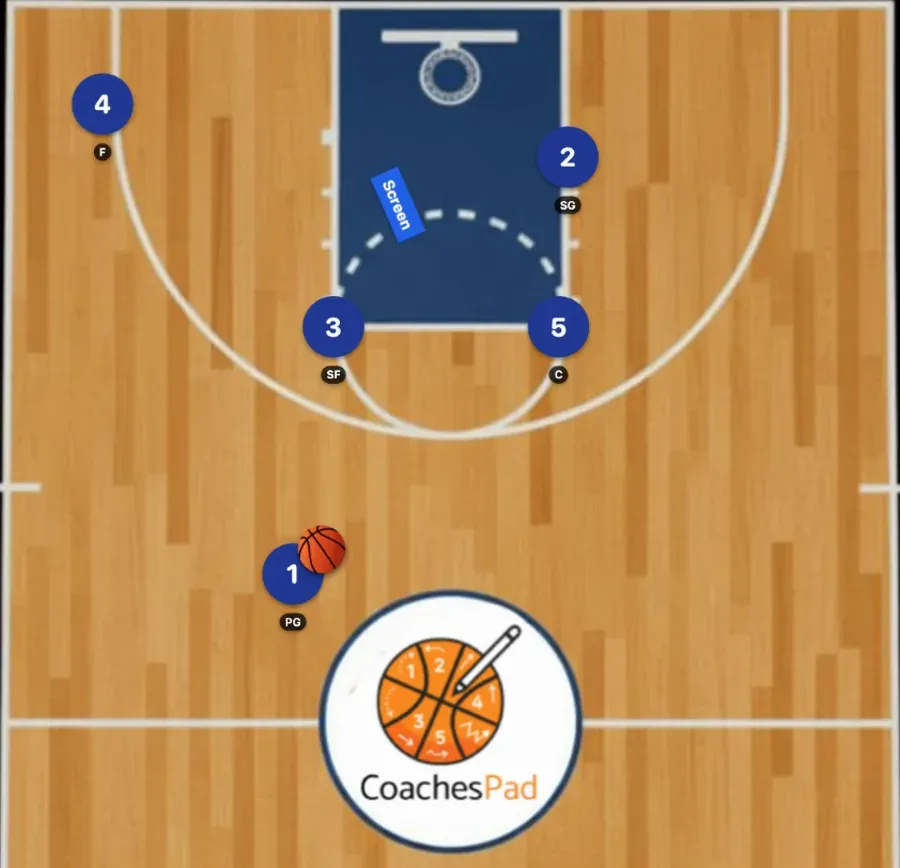
By Coach On, CoachesPad. Broken down from the game film.
Every coach who has played against a pack-line defense knows the feeling. Every drive runs into a wall of bodies at the free-throw line. The pack-line is built to stop the middle drive. It is not built to stop the drive it tells you not to take.
Eye is a Horns set Xavier ran against Maryland in the first round of the 2017 NCAA Tournament, the game 11-seed Xavier won 76-65 in Orlando. It uses three screens and a handoff to shift the defense to one side, then gets the ball to a guard in the corner and lets him drive the baseline. Three defenders collapse on him. That leaves two players open at the same time: the 5 on a 45 cut to the rim, and the 4 standing in the opposite corner. Xavier kicked it to the corner, and the 4 hit the three.
Below: the alignment, all ten actions, why the baseline drive beats a pack-line, the reads, and four practice steps.
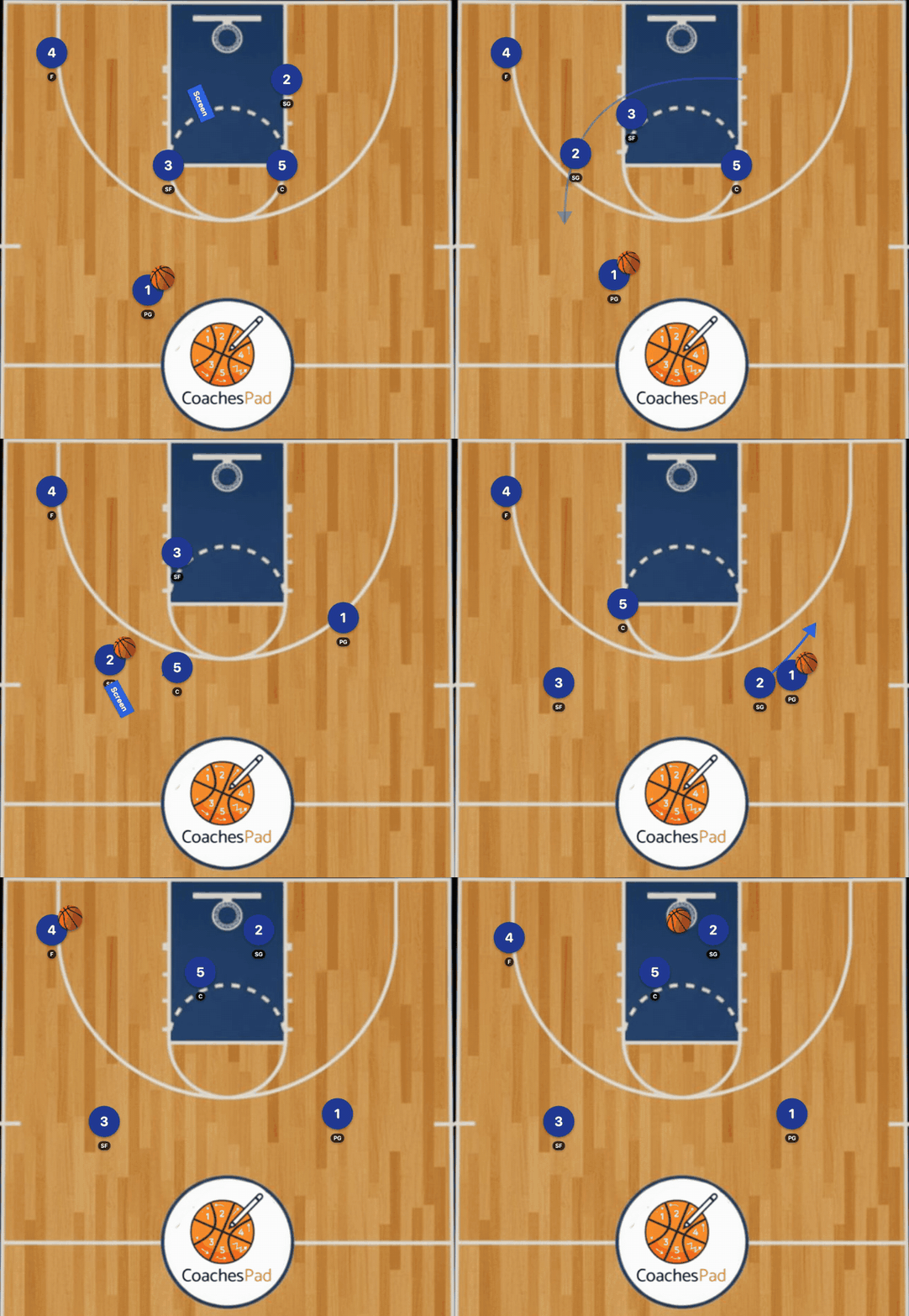
Quick summary
| What it is | A Horns set with three screens (a screen for 2, a back screen for 1, a ball screen for 2), a handoff and a return pass, then a baseline drive from the right corner that ends in a kick-out corner three or a 45 cut layup. |
|---|---|
| Formation | Horns: 1 at the top, 3 and 5 at the elbows, 2 on the right low post, 4 in the left corner. |
| Who it is for | High school, college and strong club teams with a guard who can drive the baseline under control and a shooter you trust in the corner. |
| Best against | Pack-line and any man-to-man defense that helps hard on drives. |
| Not for | Teams without a reliable corner shooter. If the 4 cannot make the shot, the defense can ignore him and the play loses its best option. |
| Get the play | Share code 4Q2CJKAF in the CoachesPad app, or open it here. |
Terms used in this play
Terminology changes from program to program, so here is exactly what each word means in this breakdown.
- Horns. A 1-2-2 alignment with the ball handler at the top of the key and two players at the elbows. In the classic version the other two players stand in the corners. Eye changes that: 2 starts on the right low post and only 4 is in a corner.
- Slot. The area between the top of the key and the wing, outside the three-point line.
- Back screen. An off-ball screen set behind the cutter's defender, usually so the cutter can go toward the basket. Also called a blind screen or rip screen.
- Ball screen. A screen set on the defender guarding the player with the ball. Also called an on-ball screen or a pick.
- DHO (dribble handoff). The ball handler dribbles toward a teammate and hands him the ball at close range. The player who hands it off becomes a screener the moment the ball changes hands.
- Handback. Our word for what happens next in this play: right after the handoff, the player who gave the ball cuts away and gets it right back on a pass. It is not a standard glossary term.
- 45 cut. A cut straight to the rim at about a 45-degree angle. Usually taught from the wing; in Eye, 5 makes it from the left elbow when the drive starts. Also called a burn cut.
- Pack-line. A man-to-man system where one defender pressures the ball and the other four sit inside an imaginary line about a foot inside the three-point arc, ready to help. It forces the middle and denies the baseline. Our pack-line defense breakdown covers it in full.
Personnel: what each spot needs
Eye has a lot of moving parts, but only 2 and 4 make the decisions. Put your best people there.
- 2 (the driver): The most important player in the play. He catches on the move, uses a ball screen, makes a handoff, and then drives the baseline from the corner under control. He keeps his eyes up through the drive, because the help decides who is open.
- 4 (left corner): Your shooter. He stands in the corner the whole possession and does nothing until the last pass. He has to stay spotted up, feet ready, when every instinct says move toward the ball.
- 5 (right elbow big): The busiest player on the floor. He back screens for 1, sets the ball screen for 2, rolls to the left elbow and makes the 45 cut. He needs to screen with contact and finish in traffic.
- 1 (point guard): Brings the ball up, makes the entry to 2, cuts off the back screen and comes back to take the handoff. Then he gets the ball straight back to 2 in the corner.
- 3 (left elbow): Sets the first screen and then lifts to the left slot. The lift pulls his defender away from the paint.
The alignment
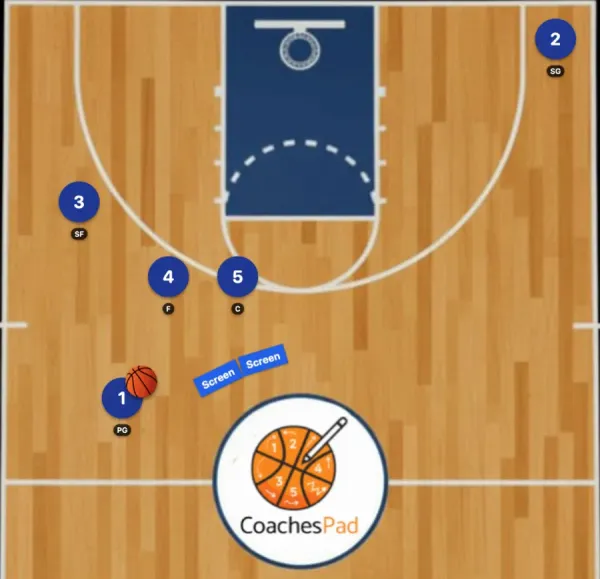
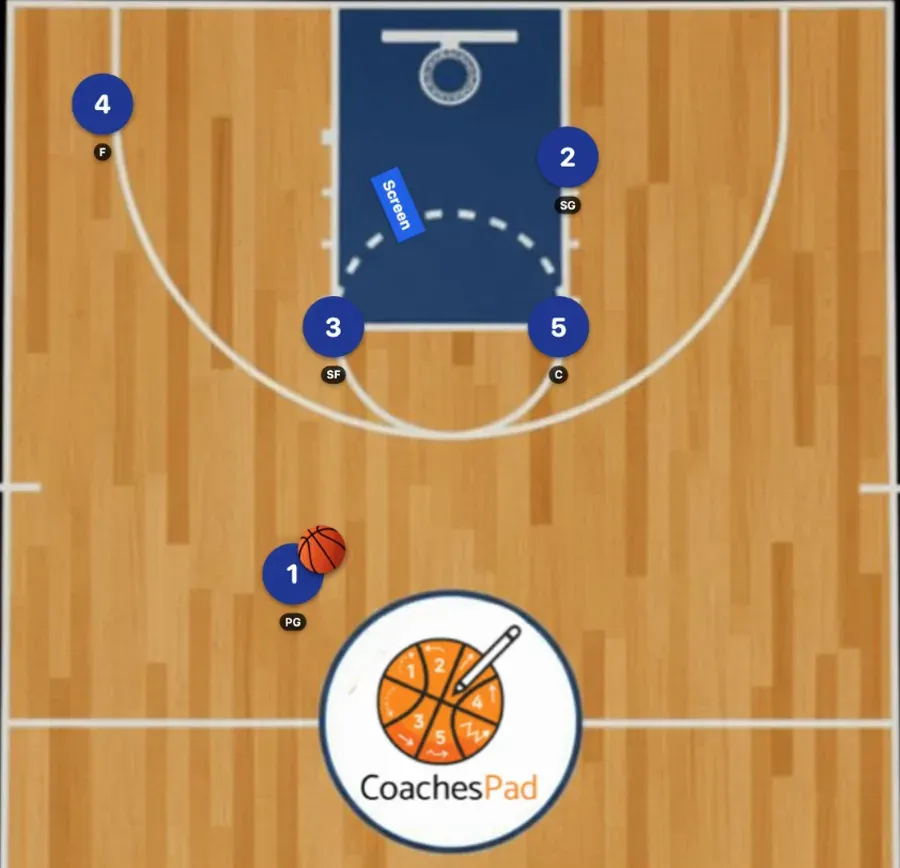
Start in Horns. 1 has the ball at the top of the key. 3 is at the left elbow and 5 is at the right elbow. 2 starts on the right low post, and 4 is spotted up in the left corner.
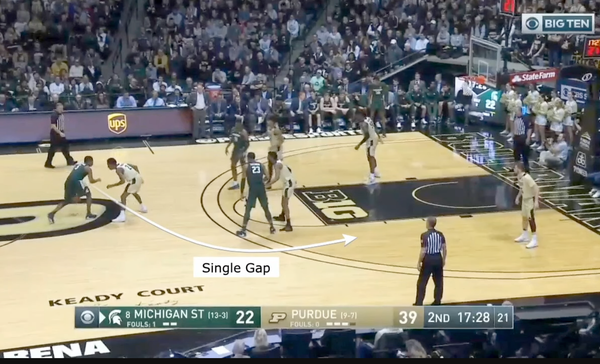
On the film the clip starts mid-action, so the opening is drawn from the Horns look the first actions come out of. The defense sees a standard set, with nothing that says the play ends on the baseline.
Step-by-step
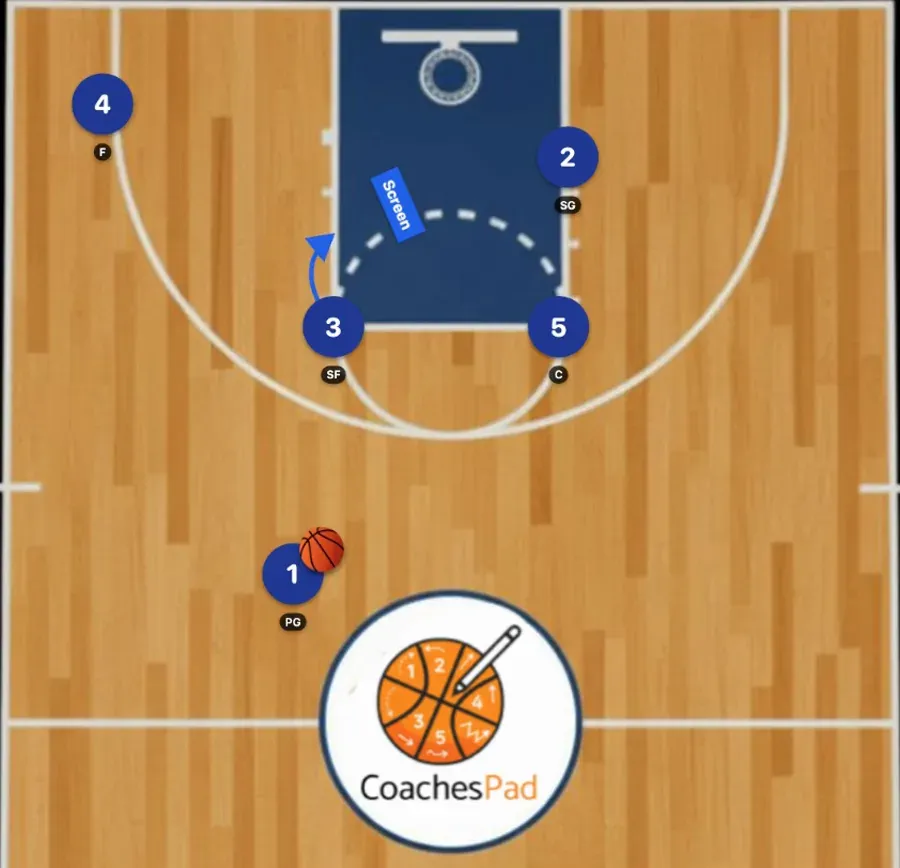
Step 1: 3 screens for 2
1 brings the ball up toward the left slot. Out of Horns, 3 steps down from the left elbow along the lane line and sets a screen for 2, who is coming across from the right low post.
The screen should be square to 2's path. Its job is to get 2 to the ball side so the play can start.
Step 2: 2 comes up to the left slot and catches from 1
2 runs the baseline side of 3, brushing his shoulder, and comes up off the screen to the left slot. 1 hits him there.
Teach 2 to come off tight. Daylight between him and the screener lets his defender slide through.
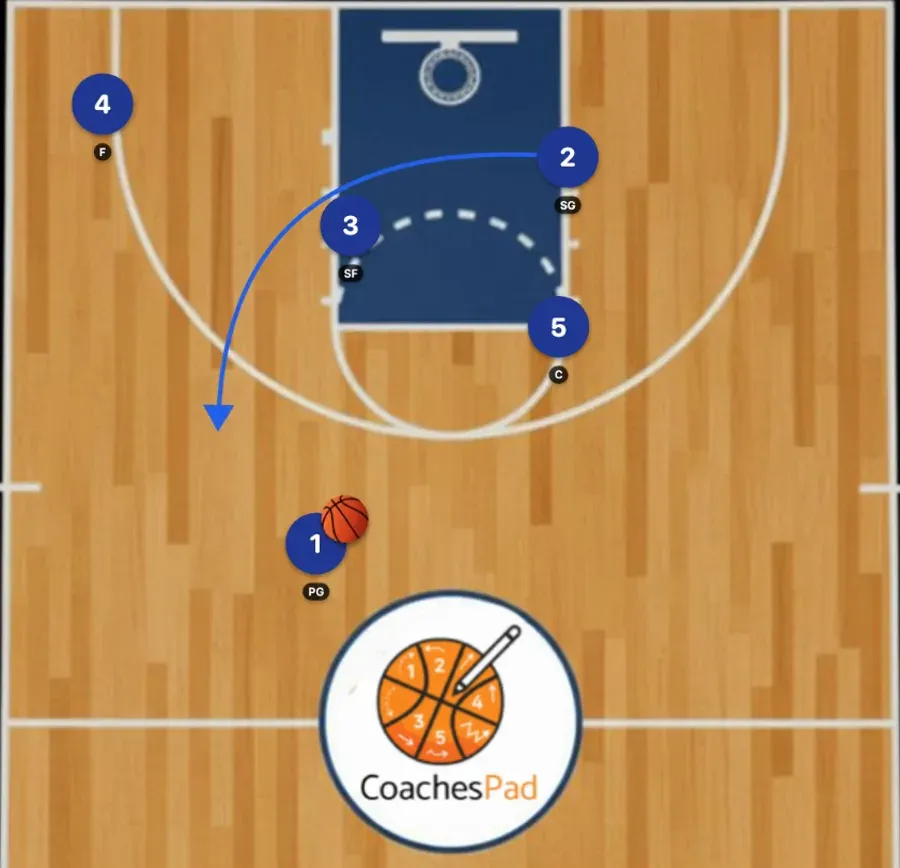
Step 3: 5 back screens for 1
Now 2 has the ball. 5 steps out from the right elbow almost to the top of the key and sets a back screen for 1, on the basket side of 1's defender.
1's defender has just watched his man pass the ball. He is facing the ball and has his back to 5. That is when a back screen works best.
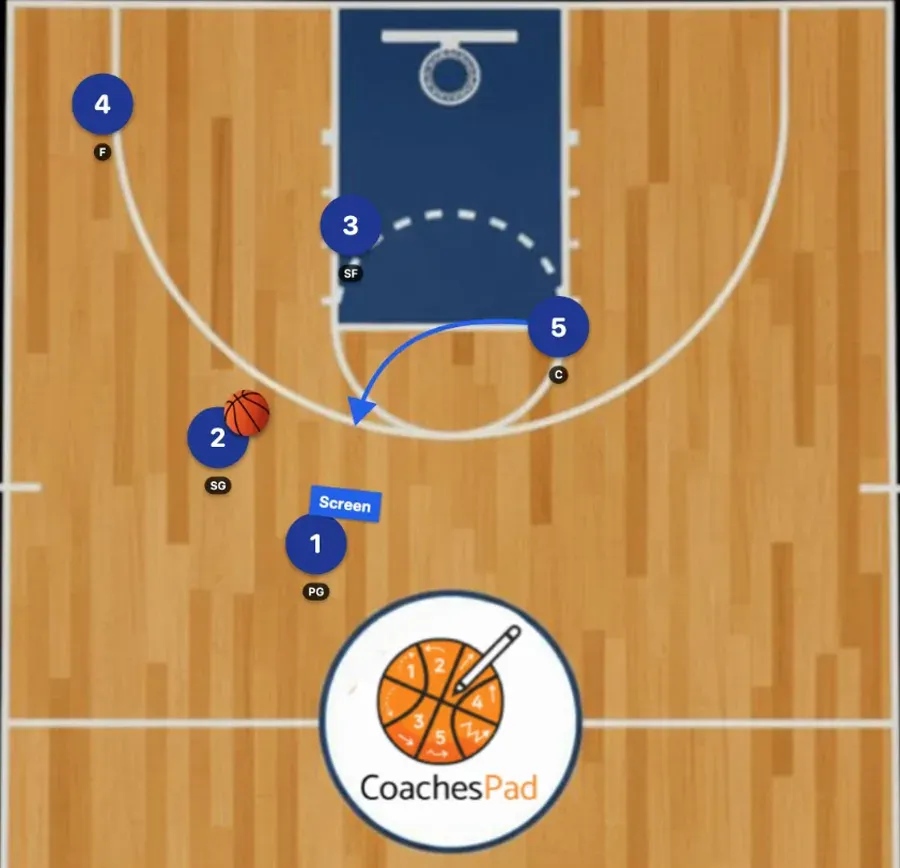
Step 4: 1 cuts off the back screen
1 cuts off 5's screen, down the lane, and out to the right side of the floor.
If 1 is open at the rim, 2 hits him. Usually a helper is sitting in the lane, and that is fine: the cut moves 1's defender to the right side and sets up the handoff.
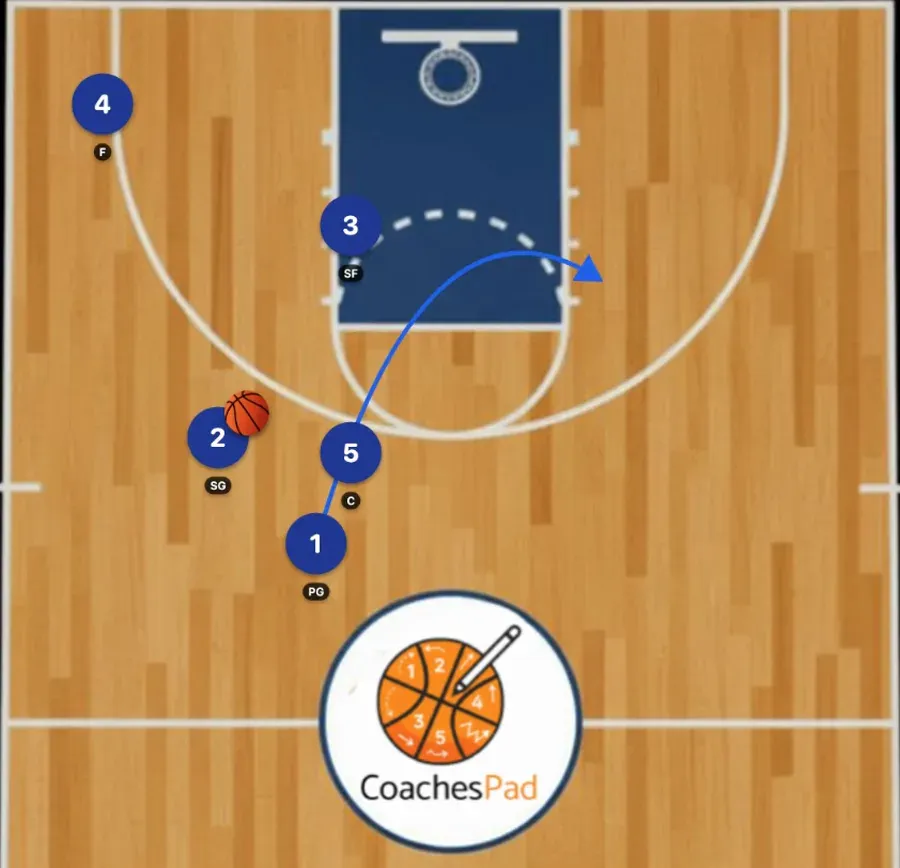
Step 5: 5 ball screens for 2
5 does not stop after the back screen. He goes straight to 2 on the left side and sets a ball screen on 2's defender.
That is three screens in under five seconds. Against a pack-line, which tells its defenders to stay connected and physical on every screen, each one is a chance for a defender to get caught or to switch.
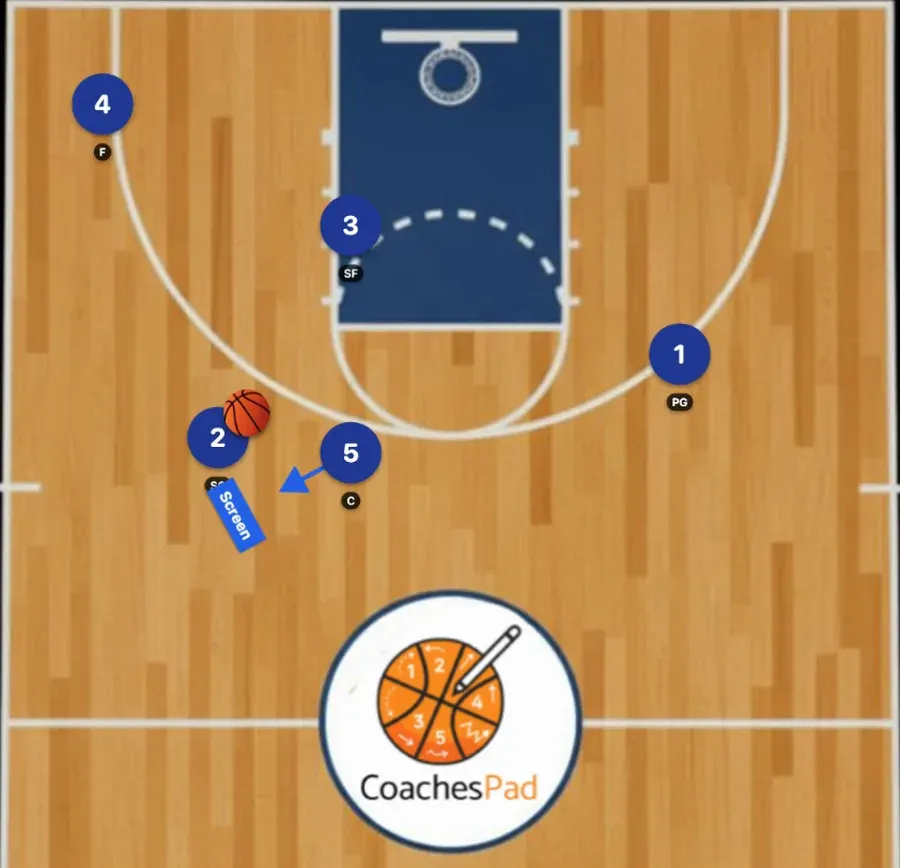
Step 6: 2 crosses the top and hands off to 1
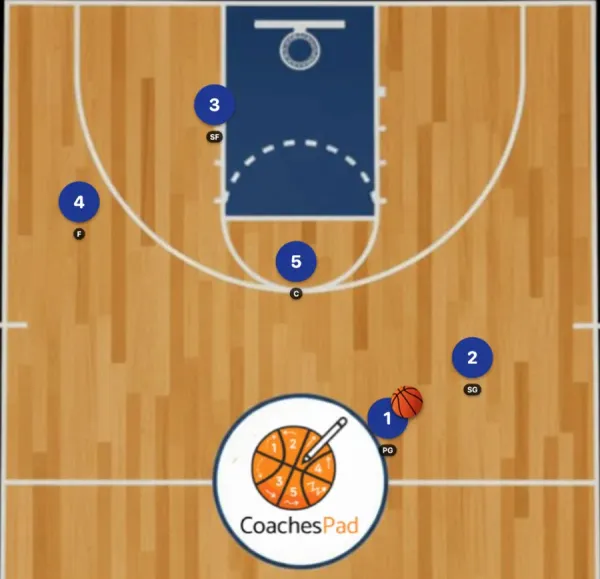
2 comes off the ball screen, dribbles across the top of the key, and hands it off to 1, who comes up from the right side to meet him just right of the top. At the same time, 5 rolls to the left elbow and 3 lifts to the left slot.
The ball has moved from the left side to the right. The pack-line shifts with every pass and dribble, so the whole defense has slid right with it.
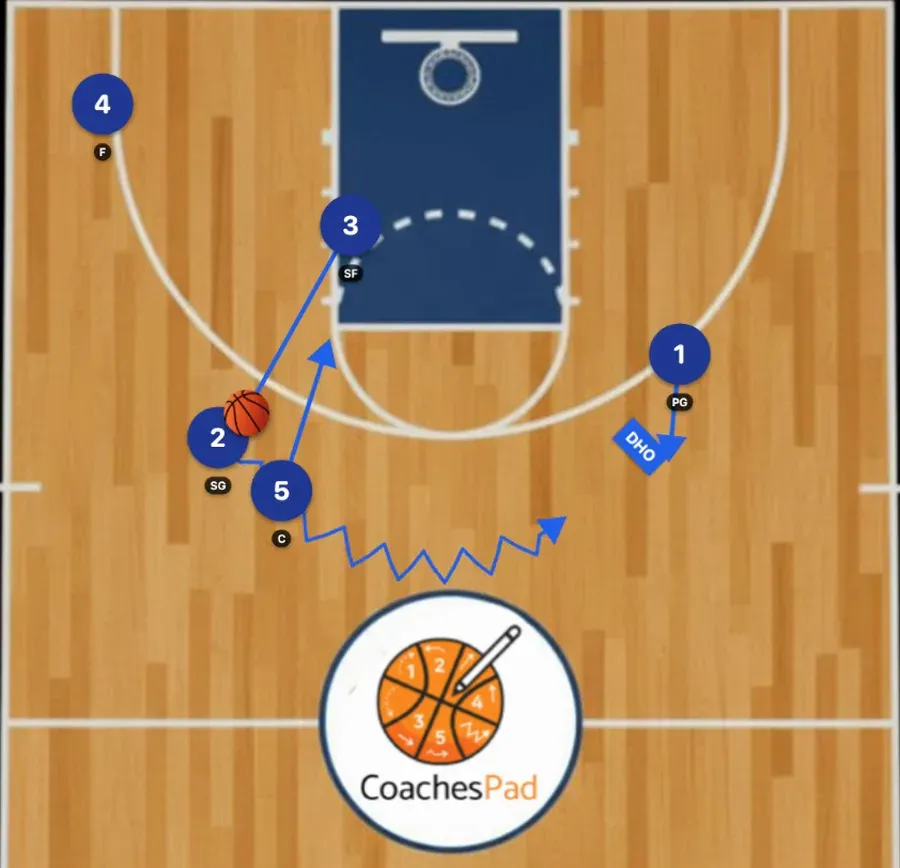
Step 7: 2 cuts to the right corner and gets it right back
Right after the handoff, 2 cuts to the right corner. 1 gives it right back to him there.
This exchange is easy to miss on film. The defense has just guarded a handoff, and now 2's defender has to chase him to the corner and close out on a catch.
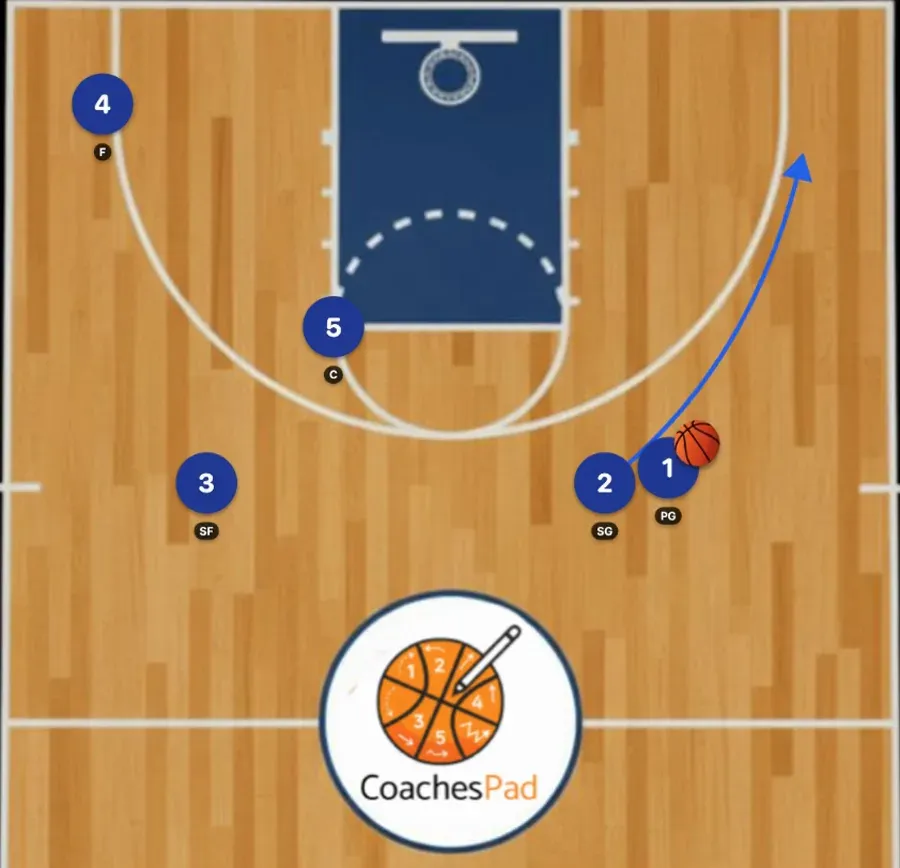
Step 8: 2 drives baseline, three defenders collapse
2 takes his man baseline from the right corner. This is the drive that breaks a pack-line defense.
The pack-line wants the ball in the middle, where four defenders are waiting. A baseline drive goes where it does not want the ball. The helpers are positioned to stop a middle drive, so they have to come down and across to meet it. On the film, three defenders collapse on 2.
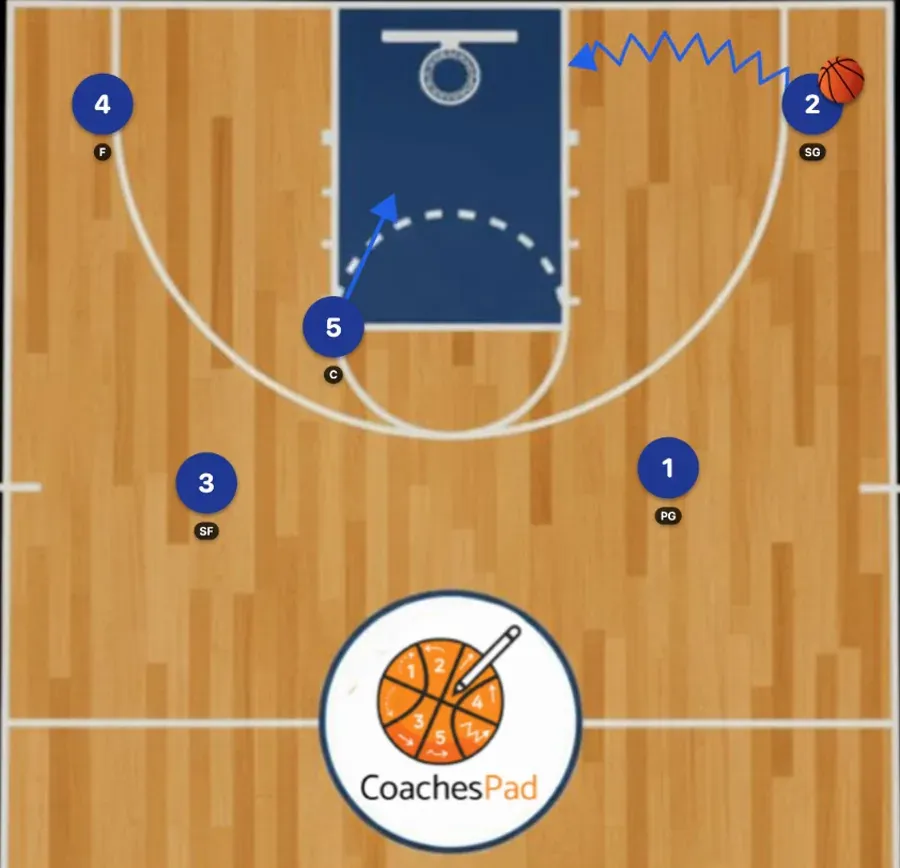
Step 9: Two options, 5 on the 45 cut or 4 in the corner
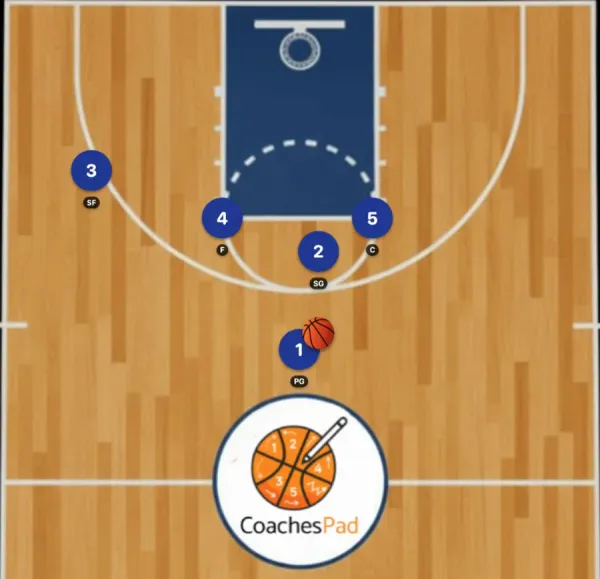
When the help collapses, 2 has two open players. 5 makes a 45 cut from the left elbow toward the rim, and he is open. Or 2 kicks it out to 4 in the left corner.
On the film, 2 kicks it to 4. Either choice was right. The defense could not cover both: the help had to stop 2 at the rim, and whoever was left on the weak side had a cutter going to the basket and a shooter in the corner.
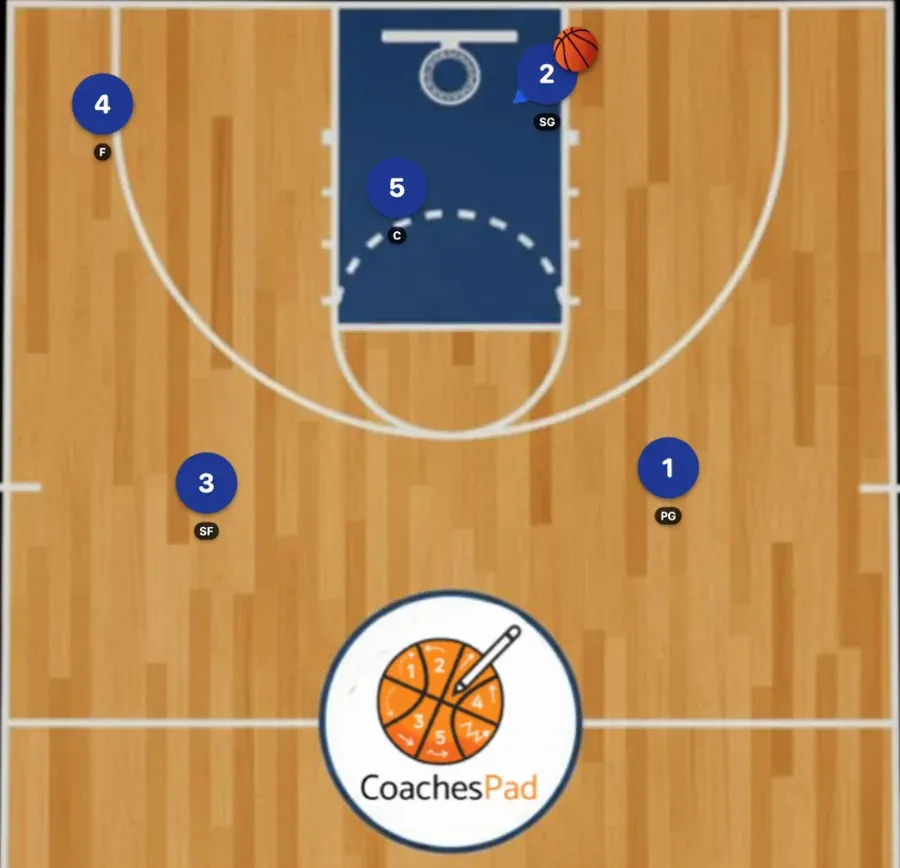
Step 10: 4 hits the corner three
4 catches in the left corner and lets it go. The closeout is late. Bottom of the net.
The shortest three on the floor, against the defender with the longest way back. That is the point of the set.
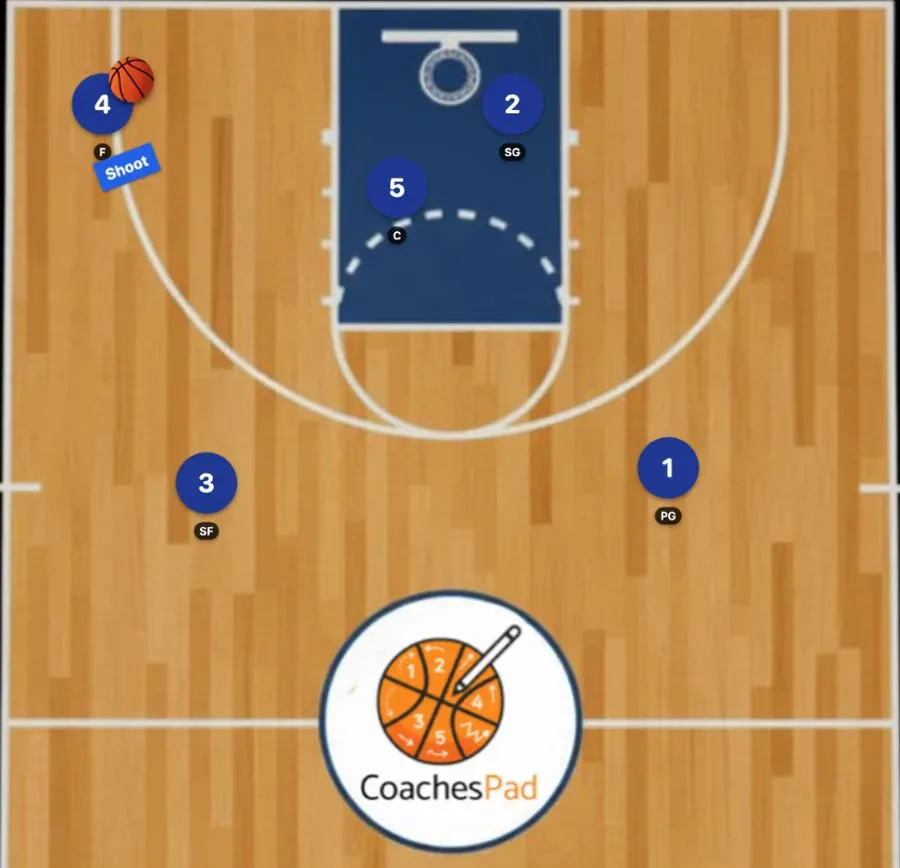
Why it works: how to beat the pack line
Most "beat the pack line" advice is general: move the ball, shoot well, play fast. Eye is a concrete answer, and each part hits one pack-line rule.
It drives where the pack-line does not want you to drive. The pack-line forces the ball to the middle and denies the baseline. All four help defenders are set up to stop a middle drive. When the drive goes baseline instead, the help is coming from the wrong angle and has to rotate down to the rim. Coaching sources name the baseline attack as one of the pack-line's weak points.
It shifts the defense first, then attacks the other side. Pack-line teams do not deny perimeter passes, so moving the ball is easy. Attacking the first side against a loaded defense is hard. Eye starts on the left side, moves the ball across the top with the ball screen and handoff, and only attacks once the ball is on the right side. By then the defense has been moved by three screens and a handoff.
The drive starts from the corner. A catch in the corner gives 2 a short, straight line along the baseline, and his defender is closing out from the handoff. A defender running at a catch cannot also take away the baseline.
The help has to come from somewhere. When three defenders collapse on the ball, two offensive players are open. The pack-line accepts that trade. Eye gives the offense two good answers on the same drive: a layup for 5 or a corner three for 4.
The 45 cut and the corner shooter work as a pair. This is a two-on-one on the weak side. The low help defender has to choose. If he helps on 2's drive or picks up 5's cut, 4 is open in the corner. If he stays home on 4, 5's 45 cut is open. One defender cannot guard both.
Every screen is a test of the pack-line's physical rules. The pack-line asks defenders to stay attached through screens and to switch only when players are matched. Three in a row means three chances for a mismatch or a late switch.
Reads and counters: defense does X, offense does Y
The film shows one possession. These reads are how to run Eye when the defense covers it differently.
| Defense does | Offense does |
|---|---|
| Help collapses on the baseline drive and the weak-side corner defender helps | Kick to 4 in the corner. That is what Xavier did. |
| The weak-side defender stays home on 4 | Hit 5 on the 45 cut. A bounce pass under the help, led to the rim. |
| 2's defender takes away the baseline and forces 2 back middle | 2 does not force it. He hits 1 back at the top and the offense resets, or he attacks middle toward the space 5 left when he rolled to the left elbow. |
| 1's defender gets caught on the back screen | 2 hits 1 on the cut down the lane before the ball screen even happens. |
| Defense switches the ball screen | 2 still crosses the top. If a big is now on 2, the corner catch and baseline drive come against a big closing out. |
| Defense denies the handoff to 1 | 1 back cuts to the rim and 2 keeps the ball, or 2 keeps it and hits 1 in the right corner. |
| 2's defender jumps the return pass to the corner | 2 cuts back door to the rim; 1 hits him or drives into the space. |
The principle behind all of these: 2 reads the help, not the play call. Teach him to see the weak-side defender before he picks up his dribble.
Teaching it in practice
Do not install Eye 5-on-5 on day one. Build it from the end backward, so the drive and its two options are automatic.
Drill 1: Baseline drive and kick (2, 4, 5)
2 starts in the right corner with the ball, 5 at the left elbow, 4 in the left corner. One defender stands in the lane as the low helper. 2 drives baseline. 5 makes his 45 cut as soon as 2 beats the first step. The defender chooses: help on 5, or close out to 4. 2 passes to whoever is open.
- Reps: 10 possessions, then rotate positions.
- Coaching points: 2 drives under control, eyes up, jump stop if the rim is covered. 4 is shot-ready before the pass. 5 cuts at the rim, not the ball.
Drill 2: Handoff and return (1, 2)
2 dribbles from the left slot across the top and hands off to 1 coming up from the right side. 2 cuts to the right corner, 1 passes it right back, and 2 drives baseline for a layup. Add a defender on 2 who chases the handoff, so 2 learns to catch in the corner and attack the closeout.
- Reps: 3 minutes, alternate driver and passer.
- Coaching points: the pass back goes to 2's outside hand. 2 catches low, ready to go.
Drill 3: 5-on-0, the whole set
Run the full play from the Horns alignment: 3's screen, the entry, the back screen, the ball screen, the handoff, the return, the drive and both finishes. Alternate the ending: one run kicks to 4, the next hits 5 on the cut.
- Reps: 8 to 10 clean runs, then 2 runs of each counter from the table on a coach's call.
- Coaching points: 5 sets two screens and must be physical on both. 3 must lift to the slot.
Drill 4: 5-on-5 against a pack-line
Have your second team play pack-line rules: one defender on the ball, four inside the line, force middle, deny baseline. The offense runs Eye on every possession for 5 minutes. Score it: 3 points for a corner three off the kick, 2 for a layup off the 45 cut or the drive, 1 for any other score off a correct read, minus 1 for a turnover on the baseline. Then tell the defense to stay home on the corner, so 2 has to read it and hit 5.
Common mistakes and fixes
- 2 drives with his head down. He picks up his dribble under the rim with nowhere to go. Fix: in Drill 1, a coach flashes a number on the drive and 2 calls it out before he passes.
- 2 drives too deep. Behind the backboard, the pass to the far corner is blocked. Fix: jump stop in front of the rim and pass.
- 4 drifts toward the ball. A corner shooter who moves up the sideline gives the defense a shorter closeout. Fix: tape a spot in the corner and make him catch on it.
- 5 cuts too early. If he cuts before the drive, he brings his defender into the lane and clogs the space 2 is driving into. Fix: the cue is 2 turning the corner on the baseline.
- Soft screens. The pack-line plays screens physically. Fix: screeners wide, low and still until the cutter passes.
- The kick-out is a lob. A slow pass across the baseline gives the defense time to close out. Fix: a firm two-hand or one-hand push pass to the shooter's chest.
Variations
- Flip it. Start 2 on the left low post and 4 in the right corner, and run everything to the other side. Useful if your best driver goes left or your best shooter likes the right corner.
- Keep the handoff. If the defense starts jumping the return pass to the corner, let 1 turn the corner off the handoff and drive middle instead. The defense now has to guard both endings.
- Early offense. The pack-line is hardest to beat once it is set. Run the ending (handoff, return, baseline drive) in transition before the defense gets organized.
Youth and high school adjustments
- Cut the screens. Ten actions is a lot for younger players. Start 2 at the left slot with the ball, skip the first screen and the back screen, and start with 5's ball screen.
- Shorten the kick-out. A pass from the right baseline to the left corner is long for younger players. Move 4 up to the left wing, or teach the bounce pass to 5 as the first read.
- Teach the jump stop first. A young driver who cannot jump stop under control will travel or charge on the baseline. Make it the first thing in Drill 1.
FAQ
How do you beat a pack line defense?
Move the ball side to side to shift the defense, then drive where it does not want you to go: the baseline. The pack-line forces drives to the middle, so a baseline drive makes its helpers rotate from the wrong angle. When they collapse, kick out to a corner shooter or hit a cutter. Shooting, physical screens and early offense also help.
What is the weakness of the pack line defense?
It gives up perimeter shots by design, and it is vulnerable when the ball gets beaten off the dribble and the defense has to collapse. It also tries to deny the baseline, so a guard who gets there anyway puts the help in a tough spot.
What is a Horns set in basketball?
Horns is a 1-2-2 alignment with the point guard at the top and two players at the elbows. In the most common version the other two players stand in the corners. Eye uses a variation with one player on the low post. Read our Horns offense breakdown for the full series, and see a different Horns ending in Nail Elbow Get.
What is a 45 cut in basketball?
A 45 cut is a cut straight to the rim at about a 45-degree angle, usually from the weak side when a teammate drives or the ball goes into the post. It punishes help defense: if the help stays with the cutter, a shooter is open; if it stays with the shooter, the cutter is open. In Eye, 5 makes it from the left elbow when 2 drives baseline.
Why is the corner three a good shot against the pack line?
It is the shortest three-point shot on the floor, and in a collapsing defense the man guarding the weak-side corner is often the low help defender. When he helps on a drive, he has the longest way back to his man. That is the shot Eye is designed to create.
Get Eye free in CoachesPad
Open the CoachesPad iPad app and type share code 4Q2CJKAF to load the animated play, or open Eye here. Step through it with your team one action at a time, flip it to the other side, and add it to your playbook.
Want more? Learn how the defense thinks in How to Run Tony Bennett's Pack-Line Defense, get the rest of the series in The Horns Offense Explained, and see another Horns set that punishes help defense in Nail Elbow Get.
Sources
- Game context (Xavier 76, Maryland 65; March 16, 2017; Amway Center, Orlando; NCAA Tournament first round, No. 11 vs No. 6 seed): CBS Sports recap and Maryland Athletics.
- Attacking the pack-line (baseline attack as a weakness, ball reversal, drive and kick, skip passes, screening, early offense): Coach's Clipboard, Attacking the Pack Line Defense; Basketball For Coaches, How to Score Against the Pack Line Defense.
- Pack-line rules (force middle, deny baseline, help positions, physical on screens): CoachesPad, Pack-Line Defense breakdown.
- 45 cut and its triggers (baseline drive, kick-out to the weak-side corner): Hooper University, Adding 45 Cuts to Your Offense; The Basketball Action Dictionary, "45 Cut".
- Back screen: Hoop Student, Back Screen; Wikipedia, Back screen.
- Ball screens and off-ball screens: Hoop Student, Basketball Screens.
- Dribble handoff: Hoop Student, Dribble Handoff; Basketball For Coaches, What Is a DHO.
- Horns formation: The Hoops Geek, Complete Guide to Horns Offense.
- Play actions: verified by the CoachesPad coaching staff from game film of the Xavier vs Maryland broadcast.