Backdoor Play: Oregon's Center Cross Fake Handoff Dunk
Center Cross Backdoor is a fake-handoff play. The 5 dribbles at the wing like he's handing it off. When the wing's defender jumps the handoff, the wing cuts backdoor and the 5 passes him the ball for a layup or dunk. Oregon ran it to beat Kansas in the 2017 Elite Eight.

By Coach On, CoachesPad. Broken down from the game film.
Every scouting report says the same thing about a dribble handoff: blow it up. Get up into the receiver, take the exchange away, make the offense start over. Center Cross Backdoor is built for the defender who listens. Your center dribbles at a wing, the wing comes up like he wants the ball, his man jumps the handoff, and the wing goes right behind him for a dunk.
Oregon ran it against Kansas in the 2017 NCAA Midwest Regional Final, the Elite Eight game in Kansas City that sent the Ducks to their first Final Four in 78 years. It is one entry, one cut, one cross, one fake and one pass. Below is how to set it up, why it works, what to do when the defense takes it away, and how to teach it in four practice steps.
Quick summary
| What it is | A man-to-man set where the center catches at the top, dribbles at a wing for a fake dribble handoff, and hits the wing on a backdoor cut when his defender jumps the handoff. |
|---|---|
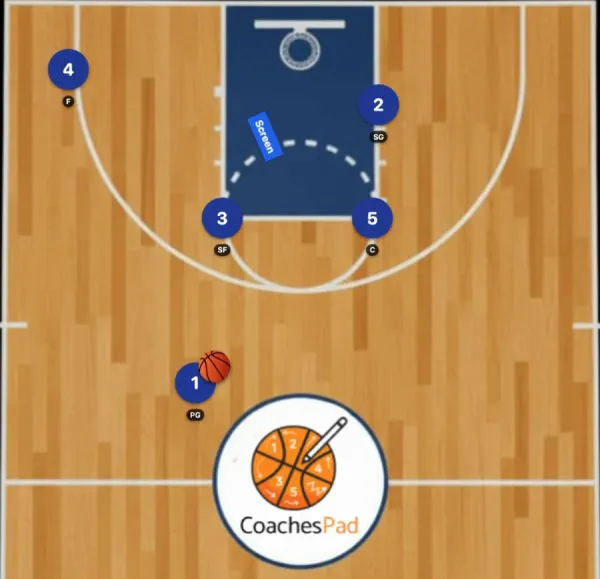
| Formation | 1 deep at the top with the ball, 5 at the high post, 2 high on the right near the top, 3 on the left block, 4 on the left wing. |
| Who it is for | High school, college and strong club teams with a center who can catch on the perimeter, put the ball on the floor for a dribble or two, and make a pass on the move. |
| Best against | Man-to-man defenses that deny the wings and attack handoffs aggressively. |
| Not for | Zone defenses, and sagging defenses that never pressure the receiver. If nobody jumps the handoff, the fake draws nobody. |
| Get the play | Share code PVNHTSVE in the CoachesPad app, or open it here. |
Terms used in this play
Coaches use these words differently from program to program, so here is exactly what they mean in this breakdown.
- Center Cross. The name of this set, not a standard term you will find in every playbook. "Center" is the 5: the whole play runs through him. "Cross" is the 3's run across the lane from the left block to the right side. The backdoor is the finish.
- High post. The area around the free-throw line, between the elbows. The 5 starts just above the line here, then steps out to the top of the key.
- Top of the key. The middle of the floor above the free-throw circle, around the three-point line. The 5 catches the entry here, facing the basket.
- Wing. The perimeter area along the sideline at about free-throw-line extended. In this play the 3 sets up lower than a normal wing, between the right corner and the right wing.
- DHO (dribble handoff). A player dribbles toward a teammate and hands him the ball at close range. The handoff player becomes a screener the moment the ball changes hands, so defenses work hard to stop the exchange before it happens.
- Fake DHO (fake handoff). The ball handler dribbles at the teammate and shows the handoff, but the ball never changes hands. The point is to get the defender to commit to an exchange that never comes.
- Jumping the handoff. The receiver's defender steps up hard, above or into the receiver, to take the handoff away. It is a good habit against a real DHO. It is exactly what this play wants.
- Dribble-at. A ball handler dribbles straight at a teammate's defender. It is a common trigger for a backdoor cut, because the defender has to choose between the ball and the space behind him.
- Backdoor cut. An off-ball cut to the basket behind the defender, away from the ball side of his body. It punishes a defender who is overplaying or denying. Compare it with a face cut, which goes in front of the defender; we cover that one in our Nail Elbow Get breakdown.
- Denial. Off-ball defense where the defender keeps a hand and foot in the passing lane to stop his man from catching. Denial is what opens backdoor cuts.
Personnel: what each spot needs
The 3 scores, but the 5 runs the play. If your center cannot handle the ball at the top, pick a different set.
- 5 (center): Oregon's Jordan Bell, number 1. He steps up from the high post to catch at the top, faces the basket, dribbles at the 3 with control and throws the backdoor pass. He needs a safe one- or two-dribble handle, good eyes, and a soft bounce pass. A center who passes well also pulls his own defender out of the lane, which matters later.
- 3 (the cutter): Oregon's Dillon Brooks, number 24. He crosses the lane, sells the handoff, and cuts backdoor. He needs a hard plant, a quick first step and the hands to catch on the move. A wing who scores a lot off real handoffs makes the fake more believable.
- 1 (point guard): Casey Benson, number 2. He brings the ball up deep, makes the entry pass and then cuts through to the left corner. The cut is not a decoy you can jog through. It takes his defender out of the middle.
- 2 (high on the right): Tyler Dorsey, number 5, who scored 27 in this game. He sits high, close to the top, not down on the wing. A shooter whose man cannot leave him keeps the right side of the floor clear for the backdoor.
- 4 (left wing): Dylan Ennis, number 31. He stays on the left wing. Spacing only, but if his defender sinks into the lane to help on the cut, he is the kick-out.
The alignment
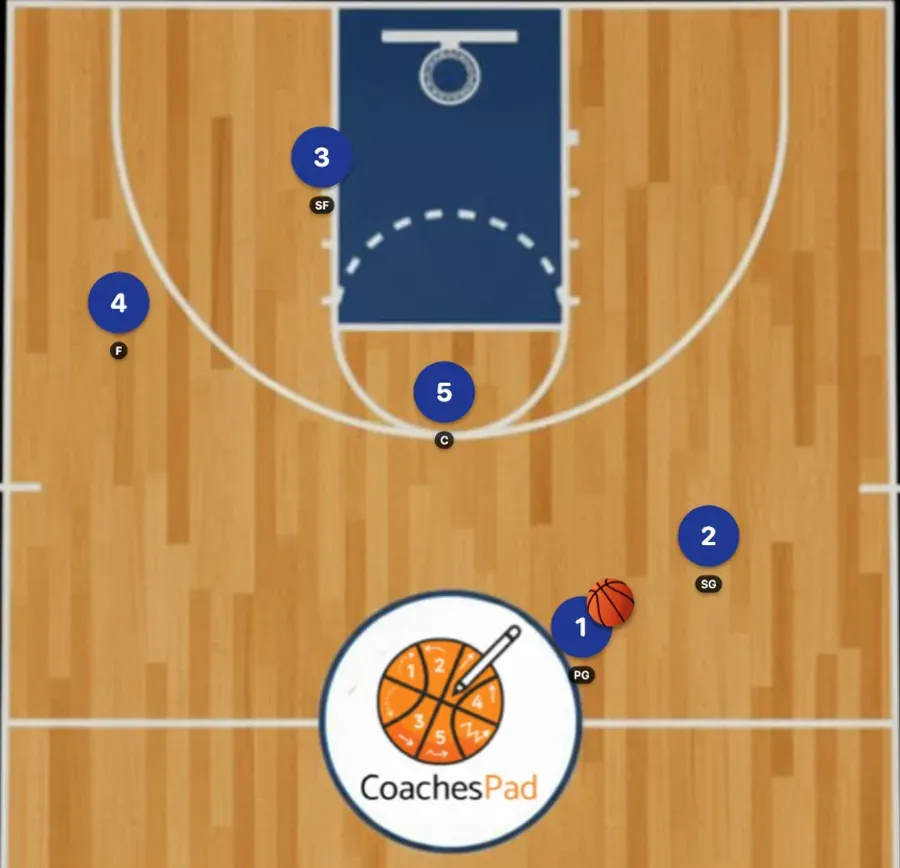
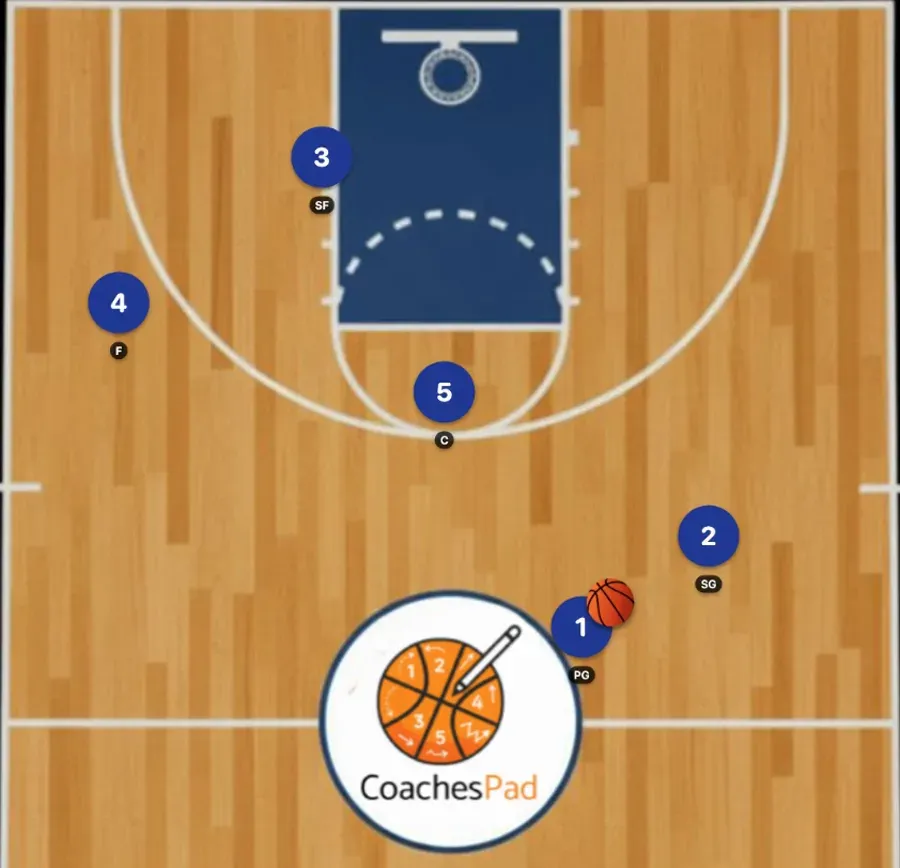
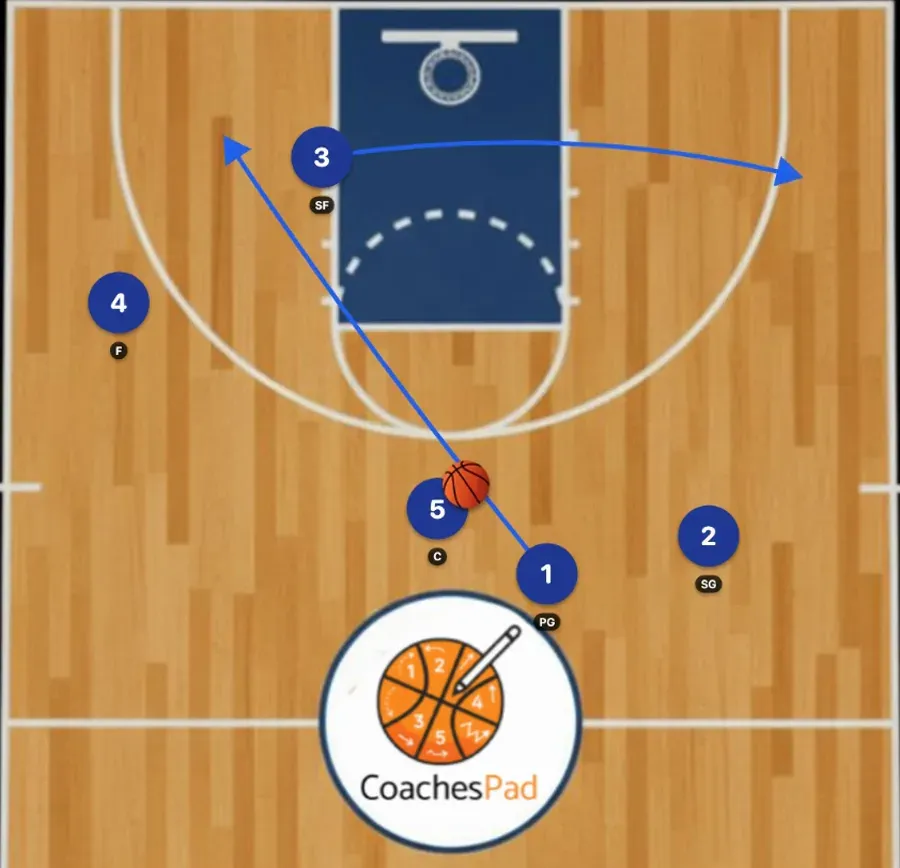
1 has the ball deep at the top, outside the arc and a little to the right of the middle. 5 is at the high post, just above the free-throw line. 2 is high on the right, closer to the middle than a normal wing. 3 is on the left block. 4 is on the left wing.
Notice what is missing: nobody on the right wing and nobody in the right corner. The whole right side below the 2 is empty on purpose. That is where the 3 is going, and it is where the backdoor ends.
Step-by-step
Step 1: The center comes to the ball
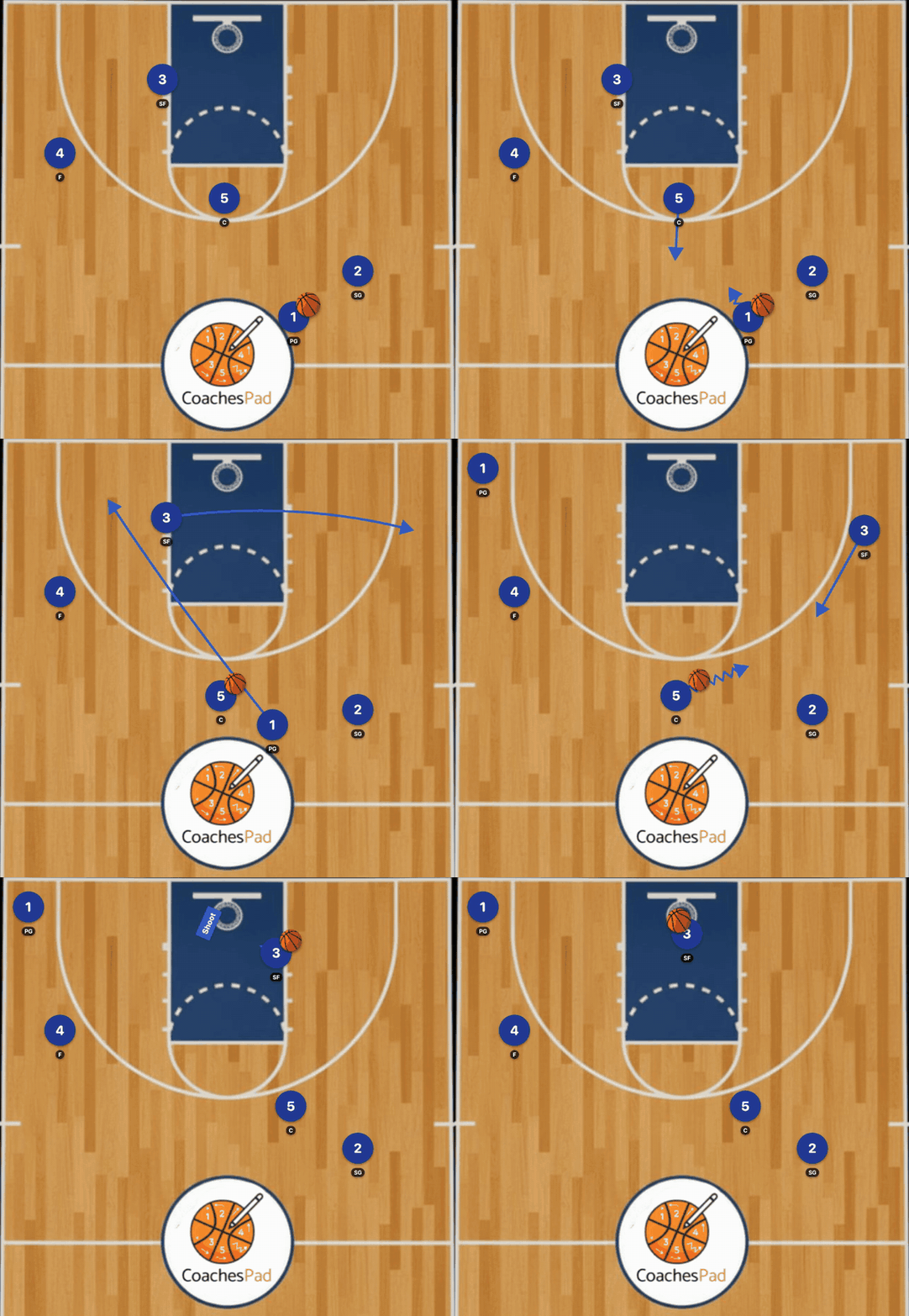
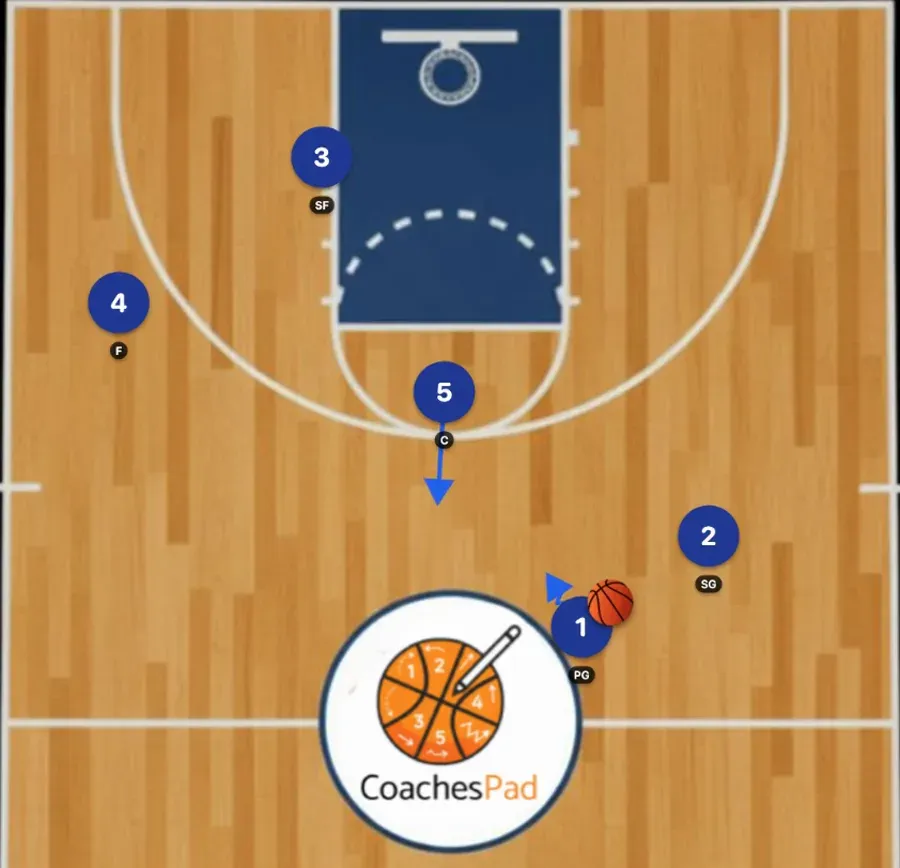
5 steps up from the high post to the top of the key. 1 dribbles in and hits him.
Two things matter here. 5 catches facing the basket, so he sees every defender. And his own defender has to come out to the top with him. The player who would normally protect the rim is now standing at the three-point line.
Step 2: The cross
Right after the pass, 1 cuts through the lane to the left corner. At the same time, 3 crosses the lane from the left block, out to the right side, and stops low, between the right corner and the right wing.
1's cut takes his defender to the left corner. The left side of the lane is now empty, and the help that would normally sit in the middle is out on the perimeter. 3's cross puts him alone on the empty right side, one-on-one with his man.
Step 3: The fake handoff
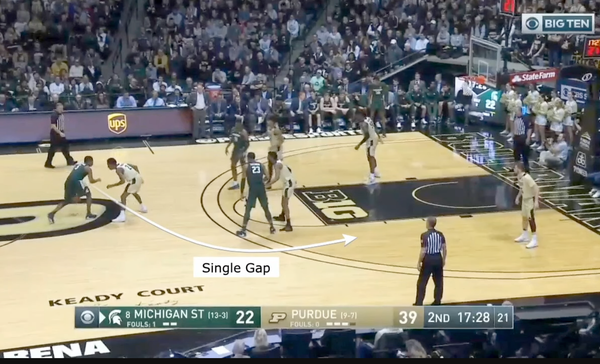
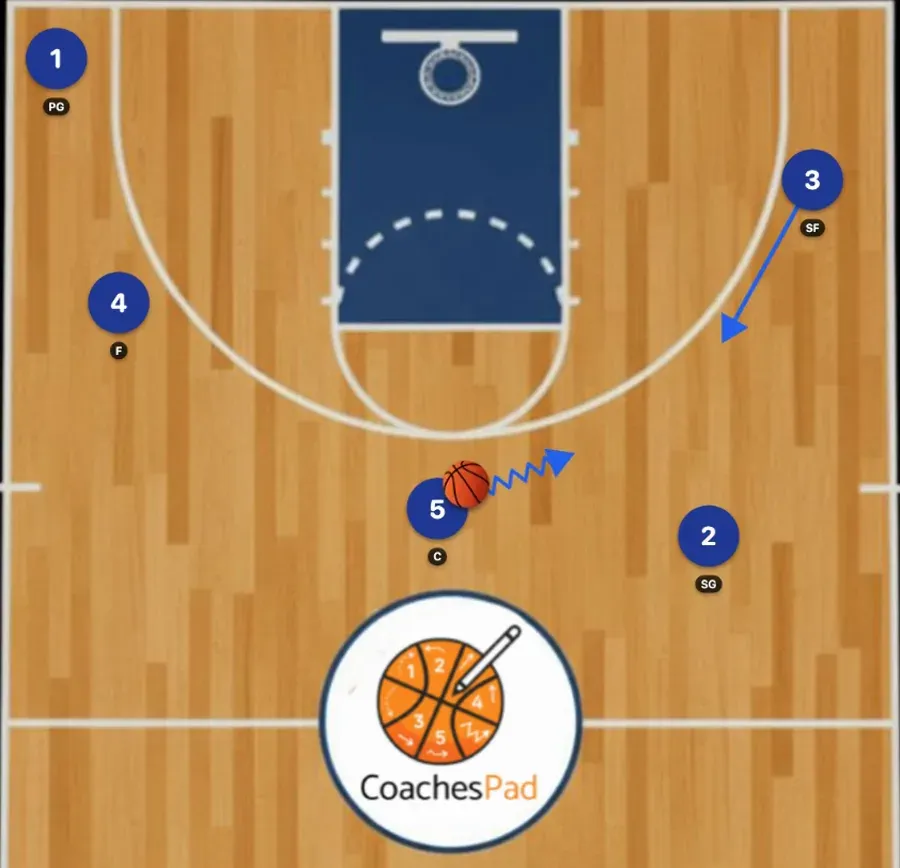
5 dribbles right at 3. 3 comes up to meet him, like he is taking a dribble handoff. On the film, 3's defender does what every coach tells him to do: he jumps up to take the handoff away.
3 has to sell it. He comes up with his hands showing and his eyes on the ball, at the same speed he would use for a real handoff. If he drifts up slowly, his man stays put.
Step 4: Backdoor
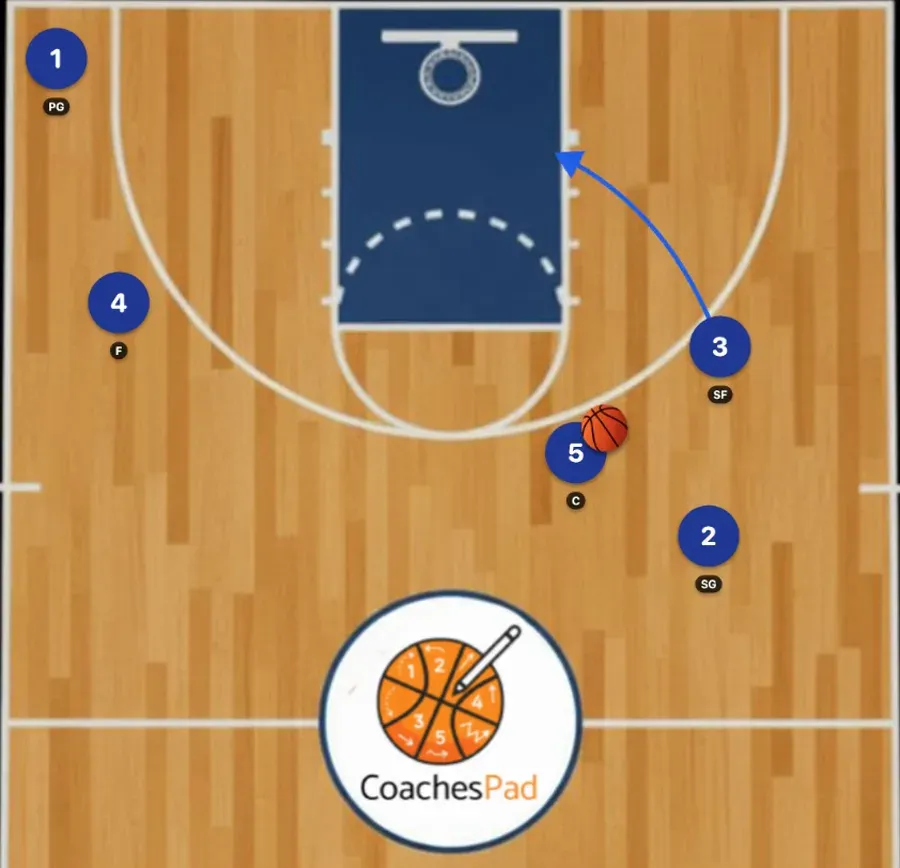
The defender jumping is the trigger. The ball never changes hands. 3 plants his outside foot and cuts backdoor, behind his man, straight to the rim. 5 drops the pass in.
The timing cue for 3 is his defender's feet, not the clock. The moment his man steps up past him toward the ball, he goes. If he cuts before the defender commits, the defender just turns and runs with him.
The pass. 5 is dribbling toward the cutter, so the pass is short. A bounce pass led to the rim side, away from the defender trailing the cut, is the safe choice. On the film it lands in stride and 3 goes straight up with it.
Step 5: The finish
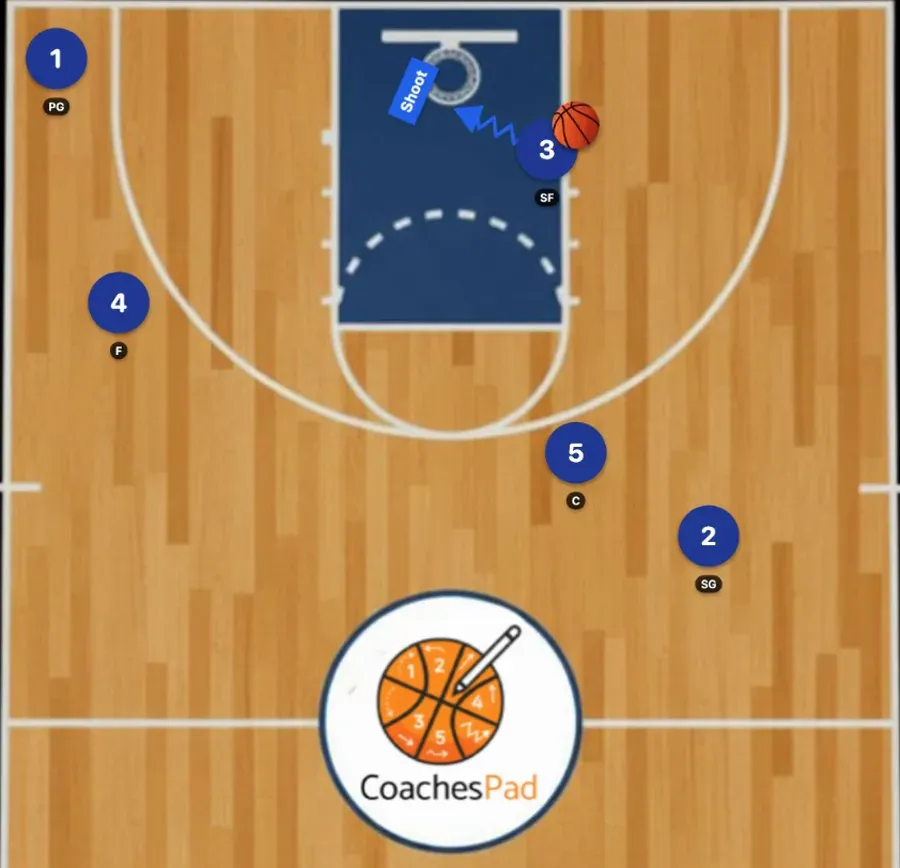
Two steps and a dunk. There is nobody at the rim, because the defender who would protect it is out at the top guarding the 5. If your 3 cannot dunk, teach a two-foot, two-hand finish. An open layup missed here wastes the whole action.
Why it works
The rim protector is at the top of the key. When 5 catches the entry out top, his defender has to go with him. Kansas's big is guarding the ball out by the three-point line at the exact moment the backdoor cut arrives at the rim.
The ball is in the right hands. 5 has it at the top, facing the basket. He can see 3, his defender, and every help defender before he makes the pass.
The help is gone. 1's cut to the left corner takes his man out of the lane, and 4 is spotted on the left wing. With 2 high on the right, nobody is stationed between the right side and the rim.
The fake looks exactly like a real action. Center dribbles at a wing, wing comes up for the handoff. Defenses see DHOs every game, and denying the exchange is good defense. The better the defender, the harder he jumps it.
Jumping and recovering are opposites. To take the handoff away, the defender steps up and toward the ball. The backdoor goes the other way. By the time he turns his hips, 3 is past him.
Reads and counters: defense does X, offense does Y
A good defense will not give you the dunk every time. Here is what you will see and what to teach.
| Defense does | Offense does |
|---|---|
| 3's defender jumps the handoff (the film read) | Backdoor. 3 plants and cuts behind him; 5 hits him with a bounce pass. |
| 3's defender stays below him or sags to protect the rim | Give the handoff for real. 3 takes it going downhill toward the middle, and 5 can roll to the rim behind it. |
| 3's defender goes under the handoff | Real handoff and 3 shoots behind it, or 5 turns and re-screens for 3 going the other way. |
| The defense switches the handoff (5's man and 3's man swap) | 5 keeps the ball and attacks the gap; a switch means both defenders committed early. If the switch leaves a guard on 5, 5 can post or drive the smaller man. |
| 5's defender sags off to protect the rim | 5 is open at the top. He can shoot, drive the open lane, or hand off for real to 3 with his man too far away to help. |
| A weak-side defender (1's man or 4's man) rotates to the rim on the cut | That defender left a shooter. 3 catches and kicks to the left corner or left wing, or 5 skips it there instead of throwing the backdoor. |
| 5 is denied at the top and cannot catch the entry | 5 backcuts to the rim from the high post, or 1 swings it to 2 high on the right and runs the same dribble-at from 2's side. |
The principle behind all of these: 3 reads his own defender, and 5 reads the help. If 3's man jumps, go backdoor. If he does not, take what he gives you.
Teaching it in practice
Do not install it 5-on-5 on day one. The play is timing between two players, so build it in this order.
Drill 1: Dribble-at backdoor (5 and 3, with a coach on defense)
5 starts at the top with the ball, 3 on the low right wing. 5 dribbles at 3, 3 comes up for the handoff. A coach guards 3 and either jumps the handoff or stays home. Jump: 3 goes backdoor, 5 hits him. Stay home: real handoff, 3 drives.
- Reps: 10 makes from each side.
- Coaching points: 3 comes up at real handoff speed with his hands showing. 5 keeps his dribble alive until the pass; picking it up early kills the fake.
Drill 2: 3-man cross (1, 5 and 3)
Add the guard and the first two actions. 1 enters to 5 at the top and cuts to the left corner; 3 crosses from the left block to the right side. Then the dribble-at and the read. Put a live defender on 3 and tell him to deny hard, then mix in reps where he plays soft.
- Reps: 3 minutes, rotate positions every make.
- Coaching points: 3 reaches his spot before 5 starts dribbling. 1 sprints his cut so he is out of the lane before the backdoor.
Drill 3: 5-on-0 with the full spacing
Run the whole play from the alignment: entry, cut and cross, fake handoff, backdoor, dunk. Then run each counter on a coach's call ("stay home," "under," "switch," "help") so players learn the second option without stopping.
- Reps: 8 to 10 clean runs, then 2 runs of each counter.
- Coaching points: 2 stays high near the top. If he drifts down to the wing, he brings a defender onto the backdoor path.
Drill 4: 5-on-5 with constraints
Live play, but the offense must run Center Cross on every possession for 5 minutes. Tell the defense ahead of time to deny the wings and jump every handoff. Points: 2 for a dunk or layup off the backdoor, 1 for any other score off a correct read, minus 1 for a turnover on the pass.
Common mistakes and fixes
- 3 cuts before his man jumps. Then it is just a basket cut, and his defender runs with him. Fix: the cue is the defender's step toward the ball, not the dribble.
- 3 fakes the handoff at half speed. Nobody bites on a lazy fake. Fix: grade 3 on the fake in film. If it does not look like a real handoff, it is wrong.
- 5 picks up his dribble too early. Once he holds the ball, the handoff threat is gone and the defender relaxes. Fix: keep the dribble alive until the pass leaves his hands.
- 2 drifts down to the wing. His defender comes with him and sits right in the backdoor lane. Fix: 2 stays high, close to the top, the whole play.
- 1 stops in the lane after the pass. His defender stays in the middle and helps on the cut. Fix: 1 sprints all the way to the left corner.
- 5 throws a lob or a soft chest pass. The trailing defender tips it. Fix: firm bounce pass led to the rim side, away from the defender.
- Running it against a zone or a sagging defense. No one is denying, so nobody jumps the handoff. Fix: save it for man-to-man teams that pressure the wings. Against a help-first system like the pack-line, the real handoff is usually the better option; our pack-line defense breakdown explains why those defenders sit inside the arc instead of jumping out.
Variations
- Flip it. Run it to the left: 3 starts on the right block and crosses to the left side, 2 sits high on the left, 4 on the right wing, and 1 cuts to the right corner.
- Give the handoff. Call it "Center Cross Give" so the team knows 5 hands it off for real and rolls. Running the real handoff a few times makes the fake work later.
- Lob option. If your 3 is a leaper and his man jumps very high, 5 can throw it over the top instead of the bounce pass.
- Out of a different set. The same fake-handoff idea works out of Horns, where the elbow big holds the ball and the cutter goes behind the fake. See it in Nail Elbow Get, and the full series in our Horns offense breakdown.
Youth and high school adjustments
- Pick your 5 by passing, not height. In youth basketball, your best ball-handling passer can play the 5 spot even if he is a guard. The play needs someone who can catch at the top, dribble at a teammate and pass.
- Teach the bounce pass only. Younger players throw lobs that float. A bounce pass to the rim side is easier to catch and harder to steal.
- Call the trigger out loud. Early on, let 3 yell "fake" as he plants. It forces him to make the read instead of cutting on a count.
- Finish with a layup. A two-foot power layup is the right finish for most youth and junior varsity players.
FAQ
What is a backdoor cut in basketball?
A backdoor cut is an off-ball cut to the basket behind your defender. It works best when the defender is overplaying: denying a pass, or, as in this play, jumping up to take away a handoff. The cutter plants, goes behind him, and catches near the rim.
What is a DHO in basketball?
DHO stands for dribble handoff. A player dribbles toward a teammate and hands him the ball at close range, then becomes a screener for him. Defenses defend it by denying the receiver, going under, switching or stepping up to hedge it.
How do you counter a defender who jumps the handoff?
Fake the handoff and go backdoor. If the receiver's defender steps up hard to take the exchange away, the space behind him is empty. The receiver plants and cuts to the rim, and the ball handler hits him with a short bounce pass. That is the whole idea behind Center Cross Backdoor.
What is the difference between a fake handoff and a dribble-at?
A dribble-at means the ball handler dribbles straight at a teammate's defender. A fake handoff adds the teammate coming up to meet the ball as if he is taking it. Both can trigger a backdoor cut; the fake handoff usually draws a bigger reaction because the defender thinks the exchange is real.
What is the high post in basketball?
The high post is the area around the free-throw line, between the two elbows. A player there can catch facing the basket and see the whole floor. In this play the 5 starts just above the free-throw line and steps out to the top for the entry.
Does a backdoor play work against a zone?
Rarely. Backdoor cuts beat defenders who are attached to their man and overplaying him. A zone defender guards an area, so he does not jump the handoff and he is often already standing between the cutter and the rim. Use this play against man-to-man.
Get Center Cross Backdoor free in CoachesPad
Open the CoachesPad iPad or iPhone app and type share code PVNHTSVE to load the animated play, or open Center Cross Backdoor here. You can step through it frame by frame with your team, flip it to the other side, and add it to your playbook.
Want more fake-handoff actions? See how Creighton used the same idea out of Horns in Horns Nail Elbow Get, learn the series behind it in The Horns Offense Explained, and see the defensive side in How to Run Tony Bennett's Pack-Line Defense.
Sources
- Game context (Oregon 74, Kansas 60; March 25, 2017; Sprint Center, Kansas City; Midwest Regional Final): CBS Sports / AP recap and Sports Illustrated on Jordan Bell.
- Oregon roster and jersey numbers: 2016–17 Oregon Ducks men's basketball team.
- Backdoor cut, dribble-at trigger and timing off the dribble: Hoop Student, Backdoor Cut; The Hoops Geek, Basketball Cuts.
- Dribble handoff, its defensive coverages (go under, hedge, switch, deny) and counters (backdoor, fake handoff, re-screen): Hoop Student, Dribble Handoff.
- Fake handoff into a backdoor cut from a high-post entry: FastModel Sports, High Post Entry with Fake Hand Off / Backdoor.
- Pack-line help position: CoachesPad, Pack-Line Defense breakdown.
- Play actions: verified by the CoachesPad coaching staff from game film of the Oregon vs Kansas broadcast.